
Famous Dobermans: real dogs behind the breed's reputation
See the real story – guest starring your dog.
Kurt was a Doberman war dog who served with the US Marine Corps on Guam during World War II. He is remembered for warning Marines of a large Japanese force and for being the first Marine war dog killed in action there. As you read about your own dog today, know that most other famous Doberman stories are working-dog history or urban legend. This guide covers the war dogs, their memorial, and the myths attached to the breed.
What is TimeWalkies?
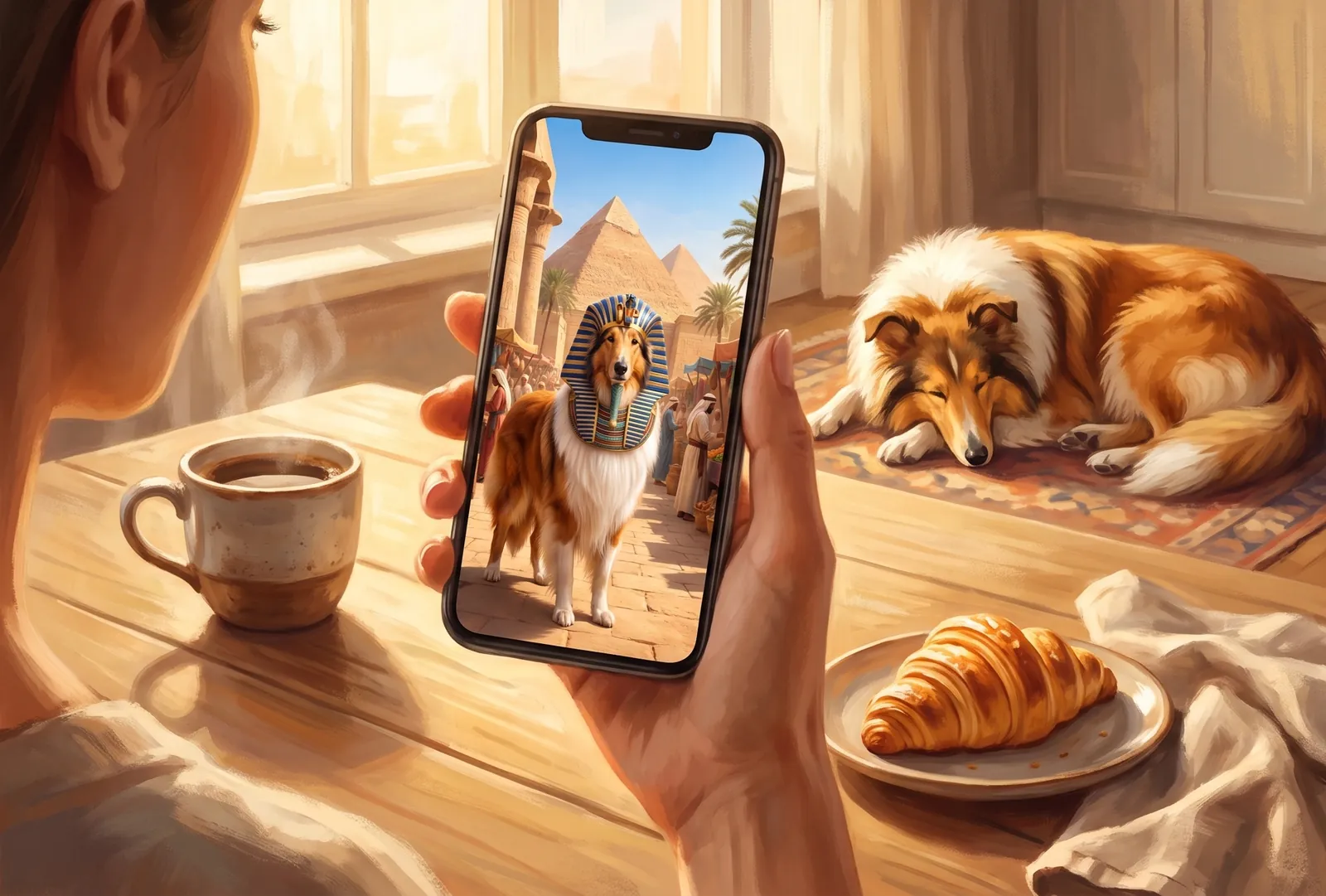
TimeWalkies paints your dog into a famous moment from history and sends it as a postcard. A new place and time every morning.
How TimeWalkies works
 Choose a photo of your dog.
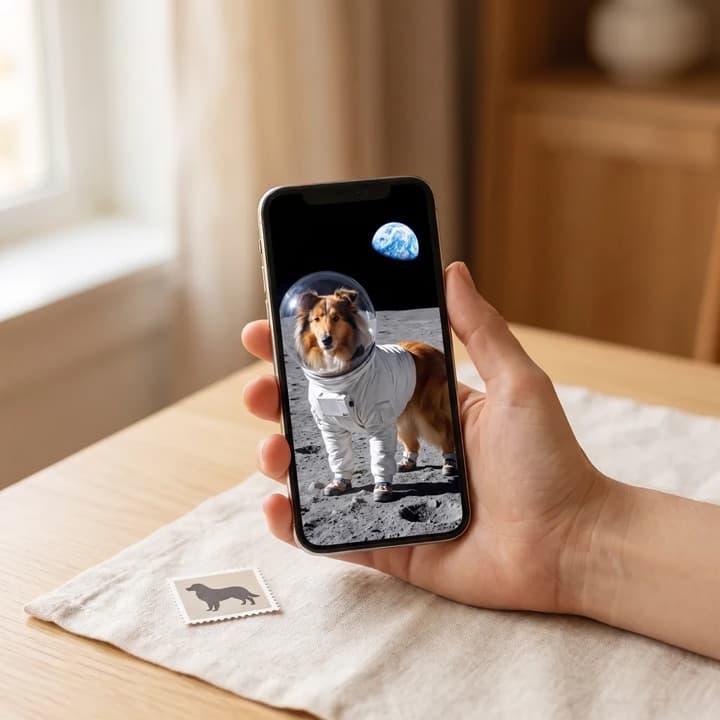 You get your first TimeWalkies postcard immediately!
 Then you get another one for free.
 If you like them, keep them coming every day for $99 for a whole year (about 27¢ per day, one‑off payment, no auto‑renewal).
2 free postcards. No credit card.
The story in 6 parts
A short version first. The full story, with every detail, is further down.
Part 1
The famous Dobermans people search for most
If you want the short version, three things come up again and again when people search for famous Dobermans.
Part 2
Kurt and the Doberman war dogs of World War II
Guam had been under Japanese occupation since December 1941, and US Marines landed to retake the island in July 1944.
Part 3
The Always Faithful memorial and war dog cemetery
The dogs killed on Guam, including Kurt, were buried near the Marines' landing point at Asan, and white headstones were added to their graves later.
Part 4
Dobermans in working roles beyond the war
Military working dog training has continued since then, including at Lackland Air Force Base, where dogs have trained since 1958.
Part 5
Myths and mix-ups: the choking Doberman story
In the story, a woman finds her Doberman choking, rushes it to a vet, and later gets a call warning her to leave the house because the dog was choking on an intruder's fingers.
Part 6
What these war dogs tell us about the breed today
The dogs that served on Guam worked as sentries, scouts, and messengers.
Read the full story
Part 1
The famous Dobermans people search for most
If you want the short version, three things come up again and again when people search for famous Dobermans.
- Kurt, the Marine war dog from the Battle of Guam, is a name with real documentation behind it.
- The Always Faithful bronze statue depicts Kurt.
- The choking Doberman story is an urban legend, and it is not a documented event.
The story of how the Doberman breed itself began is a separate history, so this guide sticks to the dogs who lived after that.
Part 2
Kurt and the Doberman war dogs of World War II
Guam had been under Japanese occupation since December 1941, and US Marines landed to retake the island in July 1944. The 2nd and 3rd War Dog Platoons landed with the Marines and worked as sentries, scouts, and messengers. The dogs explored the island's cave system, detected land mines and booby traps, and guarded sleeping Marines during more than 450 patrols. Most of these dogs were Doberman Pinschers, though German Shepherds and Labrador Retrievers also served in the platoons.
One of these dogs, a Doberman named Kurt, warned Marines of a large Japanese force ahead of them, an act credited with saving around 250 lives. Kurt was badly injured in the mortar attack that followed, along with his handler, Private First Class Allen Jacobson. Jacobson is said to have refused treatment until Kurt had been carried to safety. Kurt died from his injuries and became the first Marine war dog killed in action on Guam. Of the sixty Marine war dogs that landed on the island, twenty-five died there and twenty more were wounded. If your own dog is anywhere near that brave, you already know how much a working dog can give.
Part 3
The Always Faithful memorial and war dog cemetery
The dogs killed on Guam, including Kurt, were buried near the Marines' landing point at Asan, and white headstones were added to their graves later. By the 1980s the graves had become overgrown, until William Putney, who had commanded the 3rd War Dog Platoon, raised funds with the United Doberman Club to build a proper memorial. The remains were moved to a new National War Dog Cemetery at Naval Base Guam in June 1994, and the memorial was dedicated on July 21, 1994, the fiftieth anniversary of the battle. The bronze sculpture at the cemetery, called Always Faithful, depicts Kurt and was created by sculptor Susan Bahary. Replicas of the statue have since been placed at veterinary colleges and Marine Corps sites in the United States, including the University of Tennessee and Quantico, Virginia.
Part 4
Dobermans in working roles beyond the war
Military working dog training has continued since then, including at Lackland Air Force Base, where dogs have trained since 1958.
Part 5
Myths and mix-ups: the choking Doberman story
In the story, a woman finds her Doberman choking, rushes it to a vet, and later gets a call warning her to leave the house because the dog was choking on an intruder's fingers. The tale's first traceable appearance in the United States was in the Phoenix New Times in June 1981, reporting a version supposedly set in Las Vegas, though the paper itself noted it could not confirm the incident happened. Folklorist Jan Harold Brunvand studied the story and traced an earlier version to a Welsh fable about a dog named Gelert, showing how old the pattern is. Veterinary logic argues against the story too, since a choking dog needs immediate treatment rather than being sent home to wait. By the 1990s the dog in the story was often swapped for a pit bull instead of a Doberman, reflecting shifts in media portrayals of the breed at the time. If you hear a similar story about your own breed of dog, it is worth checking whether it traces back to a real report or just another retelling of this same legend.
Part 6
What these war dogs tell us about the breed today
The dogs that served on Guam worked as sentries, scouts, and messengers. They also explored caves and detected mines and booby traps.
Things you might not know
- The Always Faithful bronze statue depicts Kurt.
- The choking Doberman story is an urban legend, and it is not a documented event.
- Kurt died from his injuries and became the first Marine war dog killed in action on Guam.
- Military working dog training has continued since then, including at Lackland Air Force Base, where dogs have trained since 1958.
Year by year
- December 1941Guam had been under Japanese occupation since December 1941, and US Marines landed to retake the island in July 1944.
- 1958Military working dog training has continued since then, including at Lackland Air Force Base, where dogs have trained since 1958.
- June 1981The tale's first traceable appearance in the United States was in the Phoenix New Times in June 1981, reporting a version supposedly set in Las Vegas, though the paper itself noted it could not confirm the incident happened.
- July 21, 1994The remains were moved to a new National War Dog Cemetery at Naval Base Guam in June 1994, and the memorial was dedicated on July 21, 1994, the fiftieth anniversary of the battle.
Questions people ask
Who was the most famous Doberman in history?
He served with the US Marine Corps on Guam in World War II and is remembered for warning Marines of a large Japanese force before he was killed in the attack that followed.
Did Dobermans serve in World War II?
Yes, the US Marine Corps' 2nd and 3rd War Dog Platoons landed on Guam in 1944, and most of the dogs in these platoons were Doberman Pinschers, working as sentries, scouts, and messengers.
What is the Always Faithful Doberman memorial?
Always Faithful is a bronze statue depicting Kurt, the first Marine war dog killed in action on Guam. It was created by sculptor Susan Bahary and dedicated at the National War Dog Cemetery on Guam in 1994.
Are Dobermans still used as police or military dogs today?
Military working dog training continues today, including at Lackland Air Force Base, where dogs have trained since 1958.
Is the choking Doberman story true?
No, it is an urban legend. It was first traced to a 1981 Phoenix New Times report about an incident in Las Vegas that could not be confirmed, and folklorists have found earlier versions of the same story going back centuries.
Your first 2 postcards are free, with no credit card. After that, it is $14.99 a month, or a one-time $99 Year Pass for 365 days. Give TimeWalkies as a gift.
Sources
- National War Dog Cemetery - Wikipedia. en.wikipedia.org.
- The Choking Doberman. Snopes, Dec 16, 2000.
- Urban Legend: Fact or Fiction- "The Choking Doberman". NERDBOT, Apr 12, 2025.
- Choking Doberman - Wikipedia. en.wikipedia.org.
- Scary Urban Legends - The Choking Doberman. Wattpad.
- The Choking Doberman: And Other Urban Legends. Goodreads.
- Guide to the Unknown 304: The Choking Doberman and Other Urban Legends — Scary Fun. Scary Fun.
- Always Faithful | Susan Bahary Sculptor. baharystudios.com.
- Always Faithful | Land, Life & Science. landlifeandscience.tennessee.edu, Feb 13, 2024.
- The Marine Corps Has a War Dog Graveyard on Guam. Military.com, Jun 18, 2021.
Written by TimeWalkies EditorialLast updated How we research