
German shepherd Renaissance portrait: the history behind the style
The German shepherd breed began in 1899. See the real story – guest starring your dog.
You can still give your dog this look today, through illustration rather than history.
What is TimeWalkies?
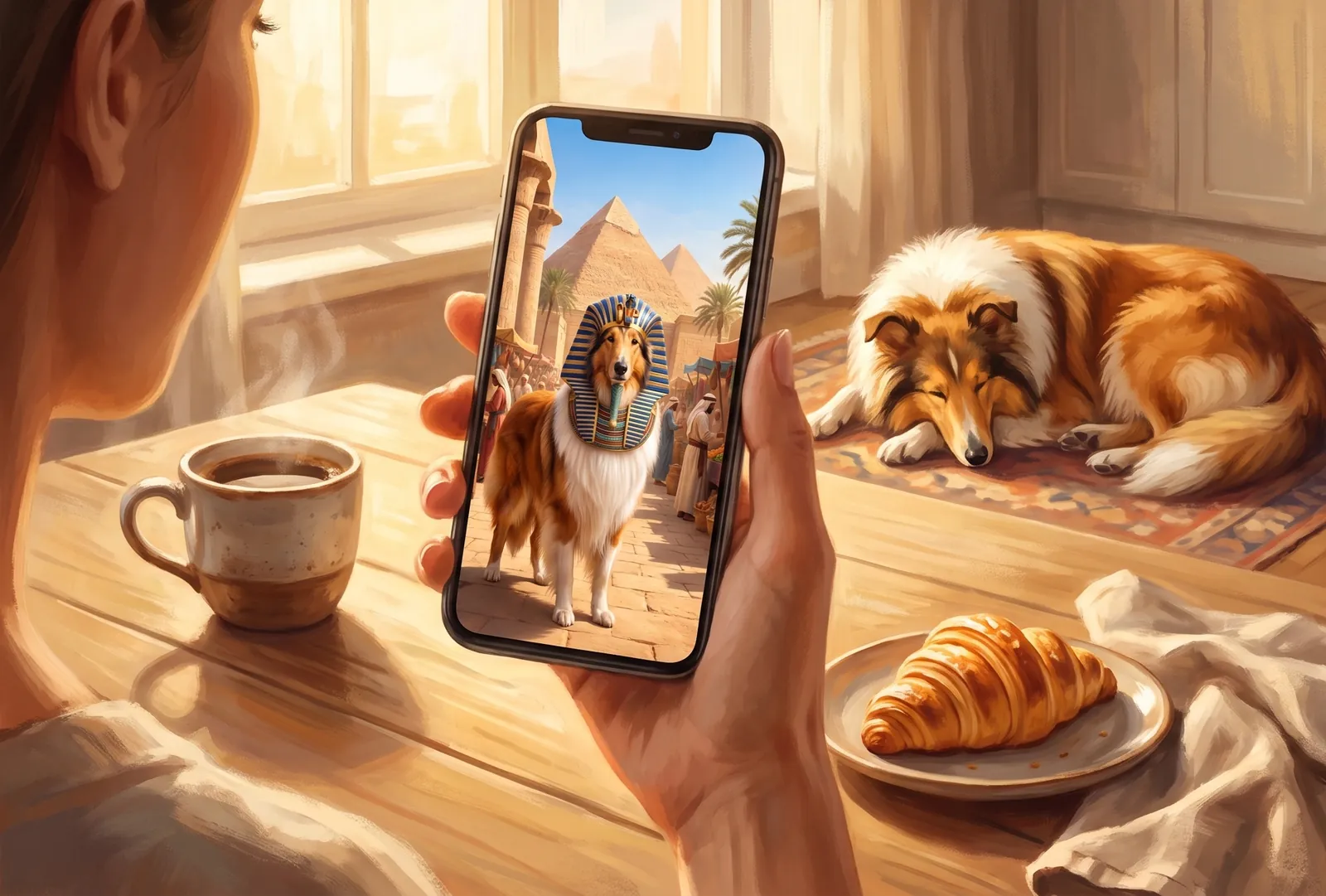
TimeWalkies paints your dog into a famous moment from history and sends it as a postcard. A new place and time every morning.
How TimeWalkies works
 Choose a photo of your dog.
 You get your first TimeWalkies postcard immediately!
 Then you get another one for free.
 If you like them, keep them coming every day for $99 for a whole year (about 27¢ per day, one‑off payment, no auto‑renewal).
2 free postcards. No credit card.
The story in 5 parts
A short version first. The full story, with every detail, is further down.
Part 1
What a German shepherd Renaissance portrait actually shows
No real Renaissance painter ever sat down with a German shepherd, because the breed did not exist yet.
Part 2
When the German shepherd breed really began
The German shepherd breed began in 1899, when Max von Stephanitz bought a dog named Hektor Linksrhein at a German dog show and renamed him Horand von Grafrath.
Part 3
Which dogs actually appear in Renaissance portraits
Jan van Eyck painted a small, carefully detailed dog in the Arnolfini Portrait, dated 1434.
Part 4
How artists and illustrators recreate this look today
A ruff collar styled after Renaissance dress.
Part 5
The appeal of placing a modern dog in a historical scene
Part of the appeal is simply seeing your dog somewhere unexpected, dressed in a style that belongs to a different century.
Read the full story
Part 1
What a German shepherd Renaissance portrait actually shows
No real Renaissance painter ever sat down with a German shepherd, because the breed did not exist yet. People enjoy the mashup because it lets your dog star in a grand historical scene without pretending the scene is real. German shepherds are known for intelligence and fast responsiveness.
Part 2
When the German shepherd breed really began
The German shepherd breed began in 1899, when Max von Stephanitz bought a dog named Hektor Linksrhein at a German dog show and renamed him Horand von Grafrath. Horand received the first registration number for the breed, and within a month von Stephanitz and a friend founded the world's first German shepherd club. Von Stephanitz combined dogs from two regions of Germany, Thuringia and Wurttemberg, to find a middle ground between their traits. Horand's descendants spread so widely that his bloodline runs through nearly every German shepherd alive today.
Part 3
Which dogs actually appear in Renaissance portraits
Jan van Eyck painted a small, carefully detailed dog in the Arnolfini Portrait, dated 1434. The National Gallery describes this dog as a precisely defined pet that may symbolize the fidelity of the couple, and other analysis of the painting calls it a rare breed of its day. Dogs also appear in religious and mythological scenes: Pisanello surrounded the huntsman Saint Eustace with dogs around 1438 to 1442, and Titian showed the goddess Diana setting her dogs on a hunter in The Death of Actaeon, painted around 1559 to 1575. Across these works, dogs reappear as a kind of visual shorthand, whether as a loyal companion at a sitter's feet or as a hunting animal beside a mythological figure. Scholars have read extra meaning into the little dog in the Arnolfini Portrait, including fidelity, with some noting its direct gaze toward the viewer. Technical study of the painting found no underdrawing for the dog, showing van Eyck added it after planning the rest of the room. Van Eyck himself was known for dense symbolism in his work, and the dog takes its place alongside other details like a single lit candle and a convex mirror that together build a scene about marriage and fidelity.
Part 4
How artists and illustrators recreate this look today
- A ruff collar styled after Renaissance dress.
- A velvet-look robe or cloak draped over the shoulders.
- A gilded frame around the finished image.
- Soft, warm lighting similar to the glow van Eyck built up through layers of oil paint.
Part 5
The appeal of placing a modern dog in a historical scene
Part of the appeal is simply seeing your dog somewhere unexpected, dressed in a style that belongs to a different century. The National Gallery notes that dogs appear in a number of its paintings, sometimes as pets in a domestic setting. The result says more about the style you enjoy than about any real moment in history. Dogs appear across paintings in the National Gallery's collection, from a pet in a domestic scene to dogs accompanying mythological figures. Choosing a historical style for your own dog continues that long habit of letting a dog share the frame. You might enjoy the contrast between an old, formal style and a dog who is anything but formal in daily life.
Things you might not know
- No real Renaissance painter ever sat down with a German shepherd, because the breed did not exist yet.
- German shepherds are known for intelligence and fast responsiveness.
- Horand's descendants spread so widely that his bloodline runs through nearly every German shepherd alive today.
Year by year
- 1434Jan van Eyck painted a small, carefully detailed dog in the Arnolfini Portrait, dated 1434.
- 1899The German shepherd breed began in 1899, when Max von Stephanitz bought a dog named Hektor Linksrhein at a German dog show and renamed him Horand von Grafrath.
Questions people ask
Did German shepherds exist during the Renaissance?
No. The breed was formalized in 1899, when Max von Stephanitz began breeding German shepherds from existing herding dogs.
What dog breeds appear in real Renaissance paintings?
Real Renaissance-era paintings show dogs such as the small companion dog in Jan van Eyck's Arnolfini Portrait and the hunting dogs that accompany Saint Eustace in a painting by Pisanello. Titian also painted hunting dogs alongside the goddess Diana in The Death of Actaeon.
Why do people make Renaissance-style portraits of their dogs?
People enjoy seeing a dog they know placed into a grand, old-fashioned style, with ruffs, velvet, and gilded frames borrowed from old master paintings. It is a playful way to frame a modern dog, not a historical claim.
How old is the German shepherd breed?
The breed dates to 1899, when von Stephanitz bought a dog named Hektor Linksrhein and renamed him Horand von Grafrath, who became the first registered German shepherd.
What symbolism did dogs have in Renaissance art?
Dogs often stood for fidelity and loyalty, as with the small dog placed between the couple in the Arnolfini Portrait. They could also appear as hunting companions alongside mythological or religious figures.
Your first 2 postcards are free, with no credit card. After that, it is $14.99 a month, or a one-time $99 Year Pass for 365 days. Give TimeWalkies as a gift.
Sources
- Jan van Eyck | The Arnolfini Portrait | NG186 | National Gallery, London. www.nationalgallery.org.uk.
- German Shepherd Dog History: From Sheep Herding Dog to Popular Companion. American Kennel Club.
- The Little Dog in The Arnolfini Portrait — Meaning. painting-meanings.com.
- Arnolfini Portrait | Visual Arts | Research Starters | EBSCOhost. EBSCO.
- The Power Of Symbolism In Art: Unpacking Hidden Layers In Van Eyck's Arnolfini Portrait -. ProminentPainting.com, Aug 21, 2025.
- How to Decipher the Symbolism in Jan van Eyck's Famous 'Arnolfini Portrait'. My Modern Met, Aug 9, 2020.
- Arnolfini Portrait - Wikipedia. en.wikipedia.org.
- Jan Van Eyck’s “The Arnolfini Portrait” – a close look. Gail Sibley, BFA, MA, Oct 13, 2013.
- Dogs | Glossary | National Gallery, London. www.nationalgallery.org.uk.
Written by TimeWalkies EditorialLast updated How we research