
Mutt origin: where the word and the mixed-breed dog came from
The word mutt began as an insult, not as a term of affection. See the real story – guest starring your dog.
A mutt most often refers to a dog with a mixed pedigree. The word itself began as an insult for a foolish person before it ever meant dog. Its story runs through old slang about sheep and the standards that kennel clubs later wrote for purebred dogs.
What is TimeWalkies?
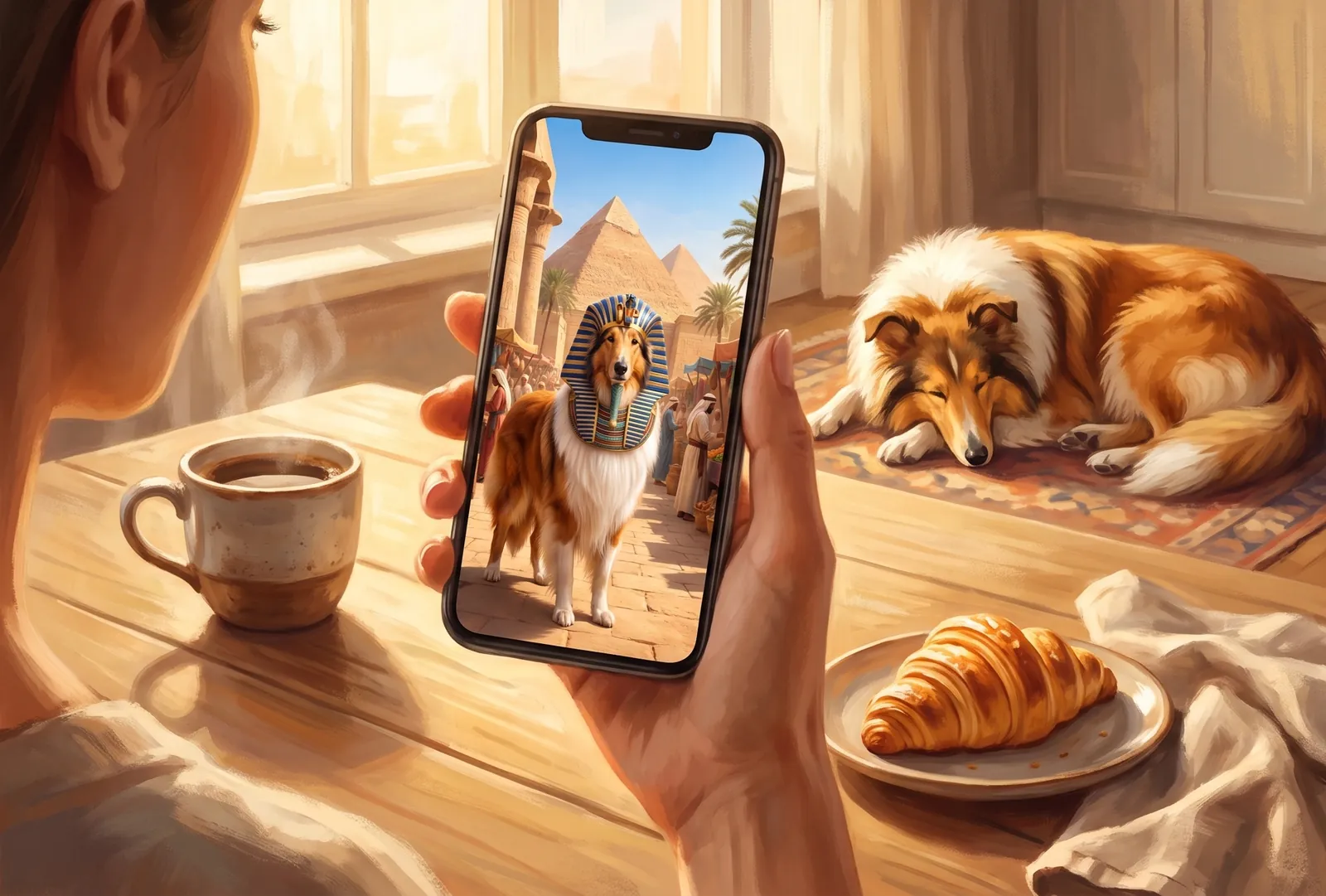
TimeWalkies paints your dog into a famous moment from history and sends it as a postcard. A new place and time every morning.
How TimeWalkies works
 Choose a photo of your dog.
 You get your first TimeWalkies postcard immediately!
 Then you get another one for free.
 If you like them, keep them coming every day for $99 for a whole year (about 27¢ per day, one‑off payment, no auto‑renewal).
2 free postcards. No credit card.
The story in 6 parts
A short version first. The full story, with every detail, is further down.
Part 1
What mutt actually means
Mutt and mongrel both point at roughly the same kind of dog, but they carry different weight.
Part 2
Where the word mutt comes from
The word mutt began as a term for a foolish person, not a dog.
Part 3
Dogs before breeds existed
Before formal breed standards existed, dogs were not sorted the way they are today.
Part 4
How Victorian breed clubs created the divide
Most modern dog breeds came out of the controlled breeding of the Victorian era, roughly 1830 to 1900, and the accurate documenting of pedigrees began with the founding of the Kennel Club in the UK in 1873, the world's first national kennel club and breed registry.
Part 5
What research says about mixed-breed dogs today
Today there are upward of 360 recognized dog breeds around the world.
Part 6
Common myths about mutts
A purebred dog's lineage can be documented for generations through registries such as the Field Dog Stud Book, whose records date back to 1874.
Read the full story
Part 1
What mutt actually means
Mutt and mongrel both point at roughly the same kind of dog, but they carry different weight. Mongrel traces to a mid-15th century word for mingling, and by the 1590s people were already using it to insult humans as well as animals. Mixed-breed is another term used for this same kind of dog.
A purebred dog is bred toward a written standard kept by a kennel club, so its line can be followed through a stud book.
Part 2
Where the word mutt comes from
The word mutt began as a term for a foolish person, not a dog. It is a shortened form of muttonhead, American slang recorded in 1803 for a dull or stupid person, built from mutton plus head. Mutton itself comes from an old word for sheep, and muttonhead borrowed the old idea that sheep are foolish animals.
Mutt is recorded by 1898 describing a dog, especially a not-very-bright one, and a related sense, a foolish person in general, is dated to 1901. Its first written use overall is often dated to 1899. By 1910, dog fancier publications were using mutt specifically for a non-purebred animal.
Part 3
Dogs before breeds existed
Before formal breed standards existed, dogs were not sorted the way they are today. Before formal standards existed, many different types of dogs existed, and people described them with a loose mix of words like breed, strain, type, and kind. Sled dogs on Zhokhov Island were bred toward a size suited to pulling sleds around 9,000 years ago, and greyhound-type and mastiff-type dogs were already recognizable in Egypt and Western Asia thousands of years later, long before anyone wrote down a breed standard.
Part 4
How Victorian breed clubs created the divide
Most modern dog breeds came out of the controlled breeding of the Victorian era, roughly 1830 to 1900, and the accurate documenting of pedigrees began with the founding of the Kennel Club in the UK in 1873, the world's first national kennel club and breed registry. In the United States, the Field Dog Stud Book has kept pedigree records dating back to 1874. Kennel clubs maintain breed standards, written descriptions of what an ideal dog of each recognized breed should be.
Part 5
What research says about mixed-breed dogs today
Today there are upward of 360 recognized dog breeds around the world.
Part 6
Common myths about mutts
A purebred dog's lineage can be documented for generations through registries such as the Field Dog Stud Book, whose records date back to 1874.
Things you might not know
- The word mutt began as an insult, not as a term of affection.
- Mutt and mongrel both point at roughly the same kind of dog, but they carry different weight.
- It is a shortened form of muttonhead, American slang recorded in 1803 for a dull or stupid person, built from mutton plus head.
- By 1910, dog fancier publications were using mutt specifically for a non-purebred animal.
- Today there are upward of 360 recognized dog breeds around the world.
Year by year
- 1803It is a shortened form of muttonhead, American slang recorded in 1803 for a dull or stupid person, built from mutton plus head.
- 1873The world's first national kennel club and breed registry.
- 1874In the United States, the Field Dog Stud Book has kept pedigree records dating back to 1874.
- 1898Mutt is recorded by 1898 describing a dog, especially a not-very-bright one,.
- 1899Its first written use overall is often dated to 1899.
- 1901A related sense, a foolish person in general, is dated to 1901.
- 1910By 1910, dog fancier publications were using mutt specifically for a non-purebred animal.
Questions people ask
What is the difference between a mutt and a mongrel?
Mutt and mongrel both describe a dog of mixed ancestry, but they come from different roots and carry different tones. Mongrel traces back to a mid-15th century word for mingling and had taken on a harsher edge by the time it was applied to humans in the 1590s. Mutt comes from muttonhead, an American term recorded in 1803, and it kept a negative edge as it came to be used for dogs.
Why are mixed-breed dogs called mutts?
The word mutt is probably a shortened form of muttonhead, American slang recorded in 1803 for a foolish person. Mutt was already being used for a not-very-bright dog by 1898, and dog fancier publications had adopted it by 1910 as a word for any non-purebred dog.
Can a DNA test tell me my mutt's exact breed mix?
A purebred dog's lineage can be traced through documented pedigrees, such as the Field Dog Stud Book records dating back to 1874.
When did the word mutt first appear?
Mutt is recorded by 1898 describing a dog, and its first written use overall is often dated to 1899. It came from muttonhead, American slang recorded in 1803 for a dull or stupid person.
Your first 2 postcards are free, with no credit card. After that, it is $14.99 a month, or a one-time $99 Year Pass for 365 days. Give TimeWalkies as a gift.
Sources
- Mutt - Etymology, Origin & Meaning. etymonline.
- Oxford English Dictionary. www.oed.com.
- MUTT'S ORIGIN AS MUDDLED AS ITS MEANING. Deseret News, Sep 15, 1996.
- Mutt or Mongrel?. FileveTlaloc.com, Nov 12, 2025.
- Muttonhead - Etymology, Origin & Meaning. etymonline.
- Mutt’s the Good Word?. A Way with Words, a fun radio show and podcast about language, Aug 2, 2012.
- Dog breed - Wikipedia. en.wikipedia.org.
- The Royal Kennel Club Timeline 1800s | Campaigns | Royal Kennel Club. www.royalkennelclub.com.
- Field Dog Stud Book (FDSB) | United Kennel Club (UKC). www.ukcdogs.com.
Written by TimeWalkies EditorialLast updated How we research