
Greyfriars Bobby: the true story behind Edinburgh's loyal dog
See Greyfriars Bobby's real story – guest starring your dog.
You have probably heard of Greyfriars Bobby, the terrier said to have guarded his owner's grave in Edinburgh for fourteen years. Bobby belonged to John Gray, a nightwatchman with the Edinburgh City Police, and became famous after Gray's death in 1858. His story grew into a citywide legend, complete with a statue and a licensed collar, but historians have since questioned how much of it is fact. This guide walks through what is known and what is disputed.
What is TimeWalkies?
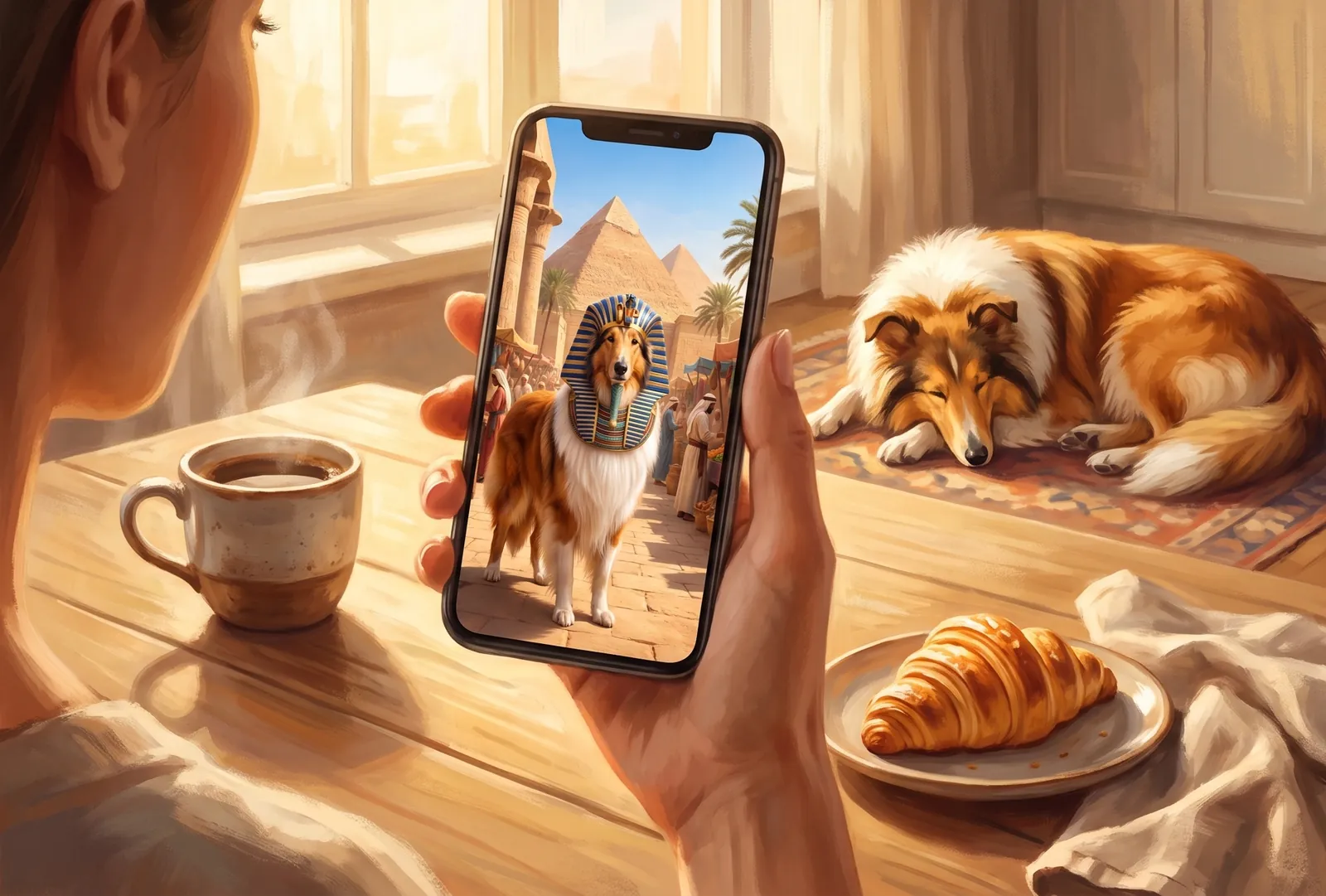
TimeWalkies paints your dog into a famous moment from history and sends it as a postcard. A new place and time every morning.
How TimeWalkies works
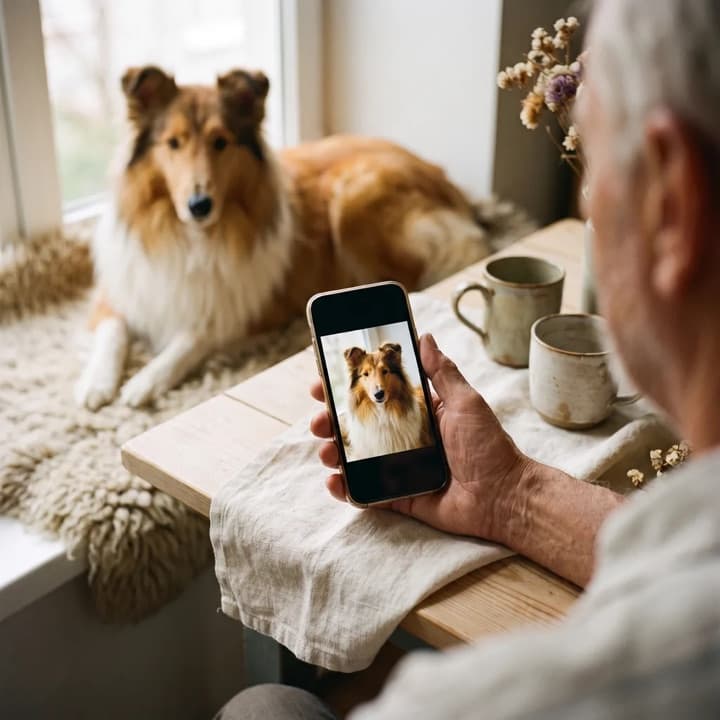 Choose a photo of your dog.
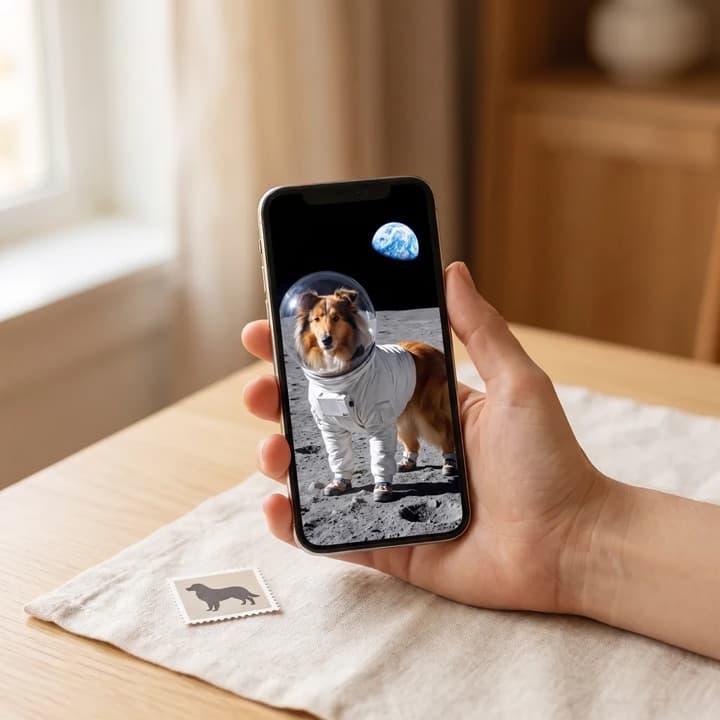 You get your first TimeWalkies postcard immediately!
 Then you get another one for free.
 If you like them, keep them coming every day for $99 for a whole year (about 27¢ per day, one‑off payment, no auto‑renewal).
2 free postcards. No credit card.
The story in 5 parts
A short version first. The full story, with every detail, is further down.
Part 1
Who was Greyfriars Bobby
Greyfriars Bobby was a dog, either a Skye Terrier or a Dandie Dinmont Terrier, who lived in Edinburgh from 1855 to 1872.
Part 2
The vigil at Greyfriars Kirkyard
According to the traditional account, Bobby spent the rest of his life sitting on his master's grave, staying there for 14 years.
Part 3
Separating fact from legend
The accuracy of the Bobby story has been challenged for a long time, including in an 1889 newspaper debate where two people who both claimed to have known the dog personally disagreed about the details.
Part 4
Edinburgh's response and the statue
In 1867 Edinburgh introduced a law requiring dogs to be licensed, and William Chambers, the city's Lord Provost and a director of a Scottish animal welfare society, paid for Bobby's license and gave him a collar.
Part 5
Bobby's legacy today
The story has been retold many times since Bobby's death.
Read the full story
Part 1
Who was Greyfriars Bobby
Greyfriars Bobby was a dog, either a Skye Terrier or a Dandie Dinmont Terrier, who lived in Edinburgh from 1855 to 1872. He belonged to John Gray, who worked as a nightwatchman for the Edinburgh City Police and was sometimes known as Auld Jock. Gray had come to Edinburgh in 1850 as a gardener before joining the police to avoid the workhouse, and Bobby is thought to have accompanied him on his rounds. If you have ever had a dog who stuck close to your side at work, you can picture the bond people described between the two of them.
Gray reportedly died of tuberculosis on 15 February 1858 and was buried in Greyfriars Kirkyard, the churchyard around Greyfriars Kirk in Edinburgh's Old Town. It was only after his death that Bobby became known locally, when the dog began spending time at the grave.
Part 2
The vigil at Greyfriars Kirkyard
According to the traditional account, Bobby spent the rest of his life sitting on his master's grave, staying there for 14 years. Locals are said to have fed and looked after him, and the kirkyard's caretaker eventually gave him shelter near the grave after first trying to chase him away. One version of the story has Bobby leaving the grave once a day, when the one o'clock gun sounded from Edinburgh Castle, to eat at a nearby coffee house. If your own dog has ever waited by a door for you, it is easy to see why this image of quiet devotion caught on.
Part 3
Separating fact from legend
The accuracy of the Bobby story has been challenged for a long time, including in an 1889 newspaper debate where two people who both claimed to have known the dog personally disagreed about the details. A common point of confusion is that there were two men named John Gray connected to the story, one a nightwatchman and one a farmer, and it is not fully settled which one the legend describes. In 2011 the historian Jan Bondeson published research arguing that the core claims about Bobby's loyalty may not be true. Bondeson noted that nineteenth-century Europe had more than sixty documented cases of dogs said to stay at graves, cared for by visitors and caretakers who fed them. He suggested the original Bobby may have died partway through the supposed vigil and been replaced by a similar-looking dog, since photographs said to show Bobby at different times appear to show different animals. A 2022 book also proposed that Bobby may have been a Dandie Dinmont Terrier rather than a Skye Terrier, an idea raised by a Dandie Dinmont club leader who pointed out that this breed was common around Edinburgh at the time. None of this proves the whole story was invented, but you should know the fourteen-year, single-dog version is a Victorian telling laid over a thinner set of confirmed facts.
Part 4
Edinburgh's response and the statue
In 1867 Edinburgh introduced a law requiring dogs to be licensed, and William Chambers, the city's Lord Provost and a director of a Scottish animal welfare society, paid for Bobby's license and gave him a collar. That collar is now held at the Museum of Edinburgh. Bobby died on 14 January 1872, and a vet who examined him at the time concluded he had died of cancer of the jaw. He was buried just inside the gate of Greyfriars Kirkyard, not far from John Gray's grave. A year later, the philanthropist Lady Burdett-Coutts commissioned a bronze statue of Bobby from the sculptor William Brodie, unveiled in November 1873 at the corner of George IV Bridge and Candlemaker Row. The fountain the statue sits on is described as one of Edinburgh's smallest listed buildings. Today, visitors rub the statue's nose for luck, even though the city discourages it because of the damage it causes.
Part 5
Bobby's legacy today
The story has been retold many times since Bobby's death. Eleanor Atkinson's 1912 novel added new details to the legend, including making Gray a shepherd known as Auld Jock, and Walt Disney based a 1961 film on that novel. A further film, released in the 2000s, told the story again, though it left out John Traill, a figure often central to the earlier tellings. In 1981 the Dog Aid Society of Scotland placed a new headstone at Bobby's grave, unveiled by the Duke of Gloucester, reading that his loyalty and devotion should be a lesson to us all. A further memorial was added near the kirkyard in 2021 to mark 150 years since Bobby's death. Whatever the exact facts, you can see why the story still resonates with anyone who has shared their life with a dog.
Things you might not know
- That collar is now held at the Museum of Edinburgh.
- The fountain the statue sits on is described as one of Edinburgh's smallest listed buildings.
- Today, visitors rub the statue's nose for luck, even though the city discourages it because of the damage it causes.
Year by year
- 15 February 1858Gray reportedly died of tuberculosis on 15 February 1858 and was buried in Greyfriars Kirkyard, the churchyard around Greyfriars Kirk in Edinburgh's Old Town.
- 1867In 1867 Edinburgh introduced a law requiring dogs to be licensed, and William Chambers, the city's Lord Provost and a director of a Scottish animal welfare society, paid for Bobby's license and gave him a collar.
- 14 January 1872Bobby died on 14 January 1872, and a vet who examined him at the time concluded he had died of cancer of the jaw.
- November 1873A year later, the philanthropist Lady Burdett-Coutts commissioned a bronze statue of Bobby from the sculptor William Brodie, unveiled in November 1873 at the corner of George IV Bridge and Candlemaker Row.
- 1981In 1981 the Dog Aid Society of Scotland placed a new headstone at Bobby's grave, unveiled by the Duke of Gloucester, reading that his loyalty and devotion should be a lesson to us all.
- 2021A further memorial was added near the kirkyard in 2021 to mark 150 years since Bobby's death.
Questions people ask
Was Greyfriars Bobby a real dog?
Yes, a dog known as Greyfriars Bobby did live in Edinburgh and became associated with Greyfriars Kirkyard after the death of John Gray in 1858. Historians have questioned some details of his story, including whether the same dog stayed at the grave for the full period described.
How long did Greyfriars Bobby guard the grave?
The traditional account says Bobby spent 14 years at his owner's grave, from 1858 until his own death in 1872. Some historians have suggested the story may involve more than one dog over that time.
What breed was Greyfriars Bobby?
Bobby is described as a Skye Terrier or a Dandie Dinmont Terrier. A 2022 book argued the Dandie Dinmont identification, noting the breed was common in the Edinburgh area at the time.
Why is there a statue of Greyfriars Bobby in Edinburgh?
The philanthropist Lady Burdett-Coutts commissioned a bronze statue of Bobby from the sculptor William Brodie, and it was unveiled in November 1873 at George IV Bridge and Candlemaker Row.
Is the Greyfriars Bobby story historically accurate?
Parts of it are supported by records, such as John Gray's death, Bobby's license paid for by the Lord Provost, and the 1873 statue. Other parts, especially the unbroken fourteen-year vigil by a single dog, have been questioned by historians such as Jan Bondeson, who pointed to photographic and record discrepancies.
Your first 2 postcards are free, with no credit card. After that, it is $14.99 a month, or a one-time $99 Year Pass for 365 days. Give TimeWalkies as a gift.
Sources
- Greyfriars Bobby - Wikipedia. en.wikipedia.org.
- Greyfriars Bobby Fountain - Wikipedia. en.wikipedia.org.
- The Enduring Loyalty of Greyfriars Bobby | GreaterGood. GreaterGood.
- Greyfriars Bobby: The Real Story Behind the Legend | Dogs in History. Dogs in History.
- Greyfrairs Bobby: The Archetypal Faithful Dog. Sniffing the Past, Jan 3, 2012.
- Greyfriars Bobby facts for kids. kids.kiddle.co.
- The Heartwarming Story Of Greyfriars Bobby, The Loyal Terrier Who Guarded His Owner's Grave For 14 Years. All That's Interesting, Apr 9, 2022.
- Greyfriars Bobby: The Legend, the Monument, and What the Record Actually Says. roamer.travel, Jul 29, 2026.
- The Legend of Greyfriars Bobby. dogs-in-history.blogspot.com.
- Greyfriars Bobby Fountain. History Hit.
- The True Story of Greyfriars Bobby | Scottish Tours. www.scottishtours.co.uk.
Written by TimeWalkies EditorialLast updated How we research