
Colonial America dog breeds: what dogs settlers actually kept
See the real story – guest starring your dog.
If you and your dog are curious about colonial America dog breeds, here is the short answer: there were no separate breeds yet, until the colonists arrived. Settlers brought English dogs, while dogs already living with Native American communities had been part of life in North America for thousands of years. Over the following generations, some of these working dogs were bred toward faster, hardier types suited to American terrain, planting the seeds of breeds that came much later.
What is TimeWalkies?
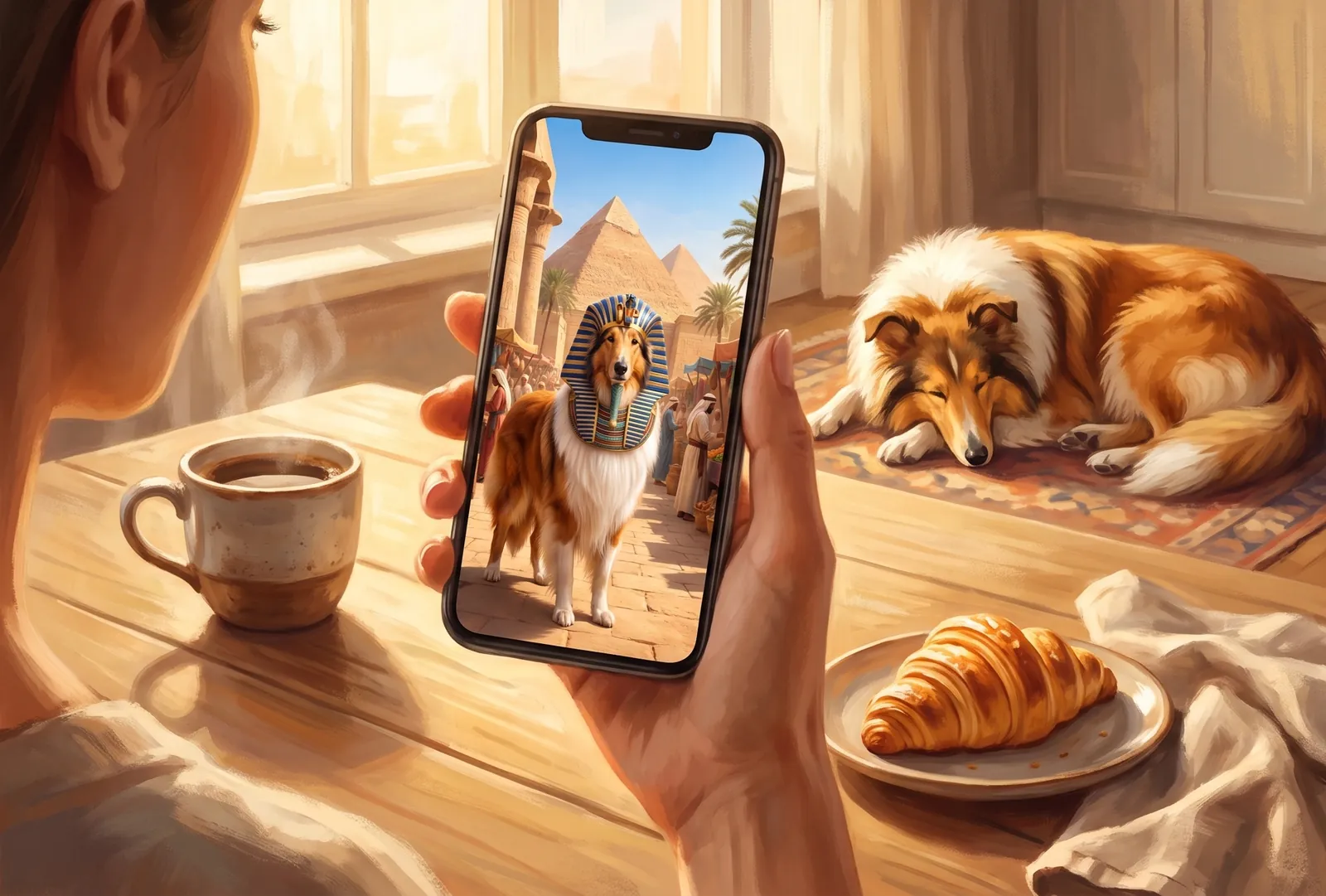
TimeWalkies paints your dog into a famous moment from history and sends it as a postcard. A new place and time every morning.
How TimeWalkies works
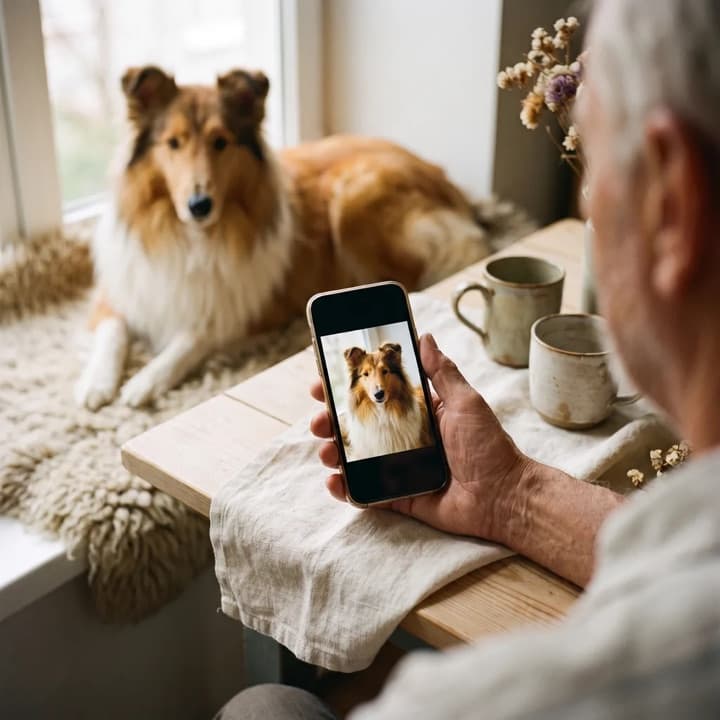 Choose a photo of your dog.
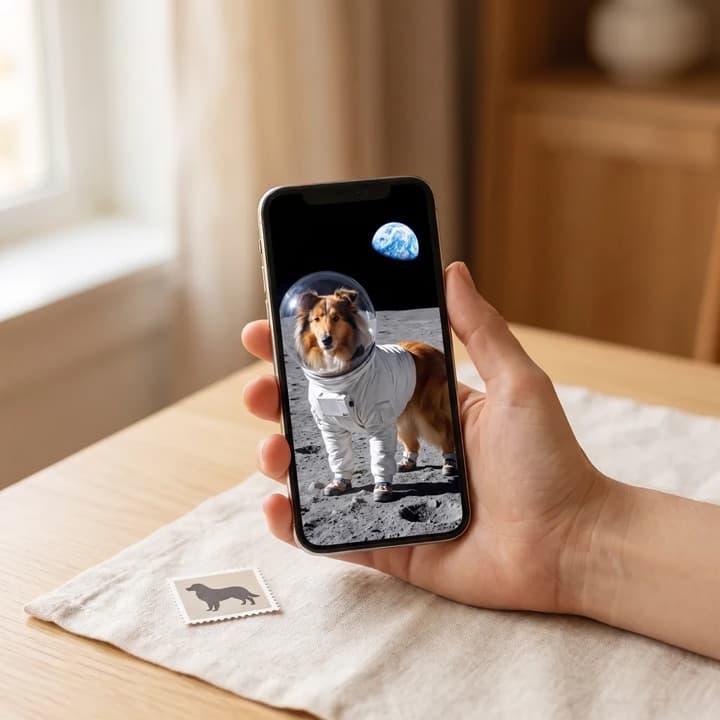 You get your first TimeWalkies postcard immediately!
 Then you get another one for free.
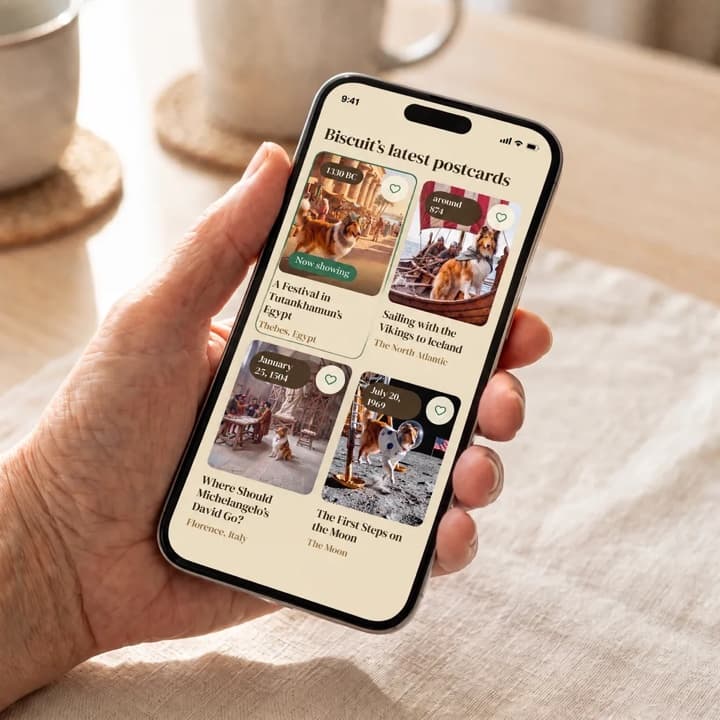 If you like them, keep them coming every day for $99 for a whole year (about 27¢ per day, one‑off payment, no auto‑renewal).
2 free postcards. No credit card.
The story in 6 parts
A short version first. The full story, with every detail, is further down.
Part 1
What kinds of dogs lived in colonial America
Jamestown settlers referred to the Indigenous dogs they encountered as mongrels, and the record states plainly that there were no separate breeds until the colonists arrived.
Part 2
Dogs settlers brought from Europe
Dogs crossed the Atlantic with the very first English colonists.
Part 3
Dogs that took shape in the colonies
You can trace some of today's American hound breeds back to specific colonial imports.
Part 4
Dogs and Native American communities
Long before any English ship arrived, Native American communities already kept dogs.
Part 5
How colonists used their dogs day to day
Hunting dogs and small lap dogs were mainly owned by English nobility, so their presence signaled the owner's status.
Part 6
What record and artifacts tell us
John Smith's writings describe the white greyhound given to Powhatan, and George Percy's account names dogs as one of the animals colonists ate during the Starving Time.
Read the full story
Part 1
What kinds of dogs lived in colonial America
Jamestown settlers referred to the Indigenous dogs they encountered as mongrels, and the record states plainly that there were no separate breeds until the colonists arrived.
Analysis of dog bones from early Jamestown suggests most of these working dogs weighed between 22 and 42 pounds, roughly the size of a modern beagle, bull terrier, springer spaniel, or standard schnauzer.
Part 2
Dogs settlers brought from Europe
Dogs crossed the Atlantic with the very first English colonists. A mastiff and a spaniel are said to have traveled aboard the Mayflower to Plymouth Colony. At Jamestown, the first recorded European dog was a white greyhound that Christopher Newport brought to Virginia in 1608 as a gift from King James I to the paramount chief Powhatan.
By 1619, more named breeds had begun to arrive in Virginia. That year, Virginia's General Assembly made it illegal to sell or give mastiffs, greyhounds, bloodhounds, or land and water spaniels to Native Americans, a law that names these breeds specifically because they had begun arriving by then.
These English dogs were not built for their new home. The English Foxhound, for example, had relatively heavy bone suited to hedgerow-dotted English countryside, not the open, vast landscape colonists found in America. That mismatch is part of why later breeders in the colonies started adapting these imports rather than keeping them unchanged.
Part 3
Dogs that took shape in the colonies
You can trace some of today's American hound breeds back to specific colonial imports. In 1650, a settler named Robert Brooke sailed from England to Maryland with his family, 28 servants, and a pack of hunting hounds. Dogs from this bloodline, later called Brooke Hounds, stayed within the Brooke family for nearly 300 years.
George Washington is credited as a key figure in developing the American Foxhound. He kept his own strain of hounds at Mount Vernon, which he called Virginia Hounds, and hoped to breed a dog with speed, sense, and brains. The Marquis de Lafayette sent Washington a group of French hounds, and Washington crossed these with his lighter Virginia pack, a combination that eventually developed, with later breeders, into the modern American Foxhound.
As hunters pushed west into places like Ohio and Tennessee, they kept adapting their hounds to new terrain and new game. The American Foxhound became the basis for several later Coonhound breeds, including the Treeing Walker, American-English, and Bluetick.
Part 4
Dogs and Native American communities
Long before any English ship arrived, Native American communities already kept dogs. To the English, these dogs looked something like foxes, and one colonist described them as unable to bark, only howl. Indigenous dogs were roughly the size of a modern beagle or springer spaniel, around 35 pounds, while the English brought dogs closer to the size of shepherds, around 50 to 70 pounds. Native communities in eastern Virginia are thought to have used their dogs as sentinels and hunting assistants, and English accounts from the time reported that they did not eat them, unlike the colonists.
Genetic testing tells a more tangled story about which dogs were actually living at Jamestown. Ancient DNA from dogs found at Jamestown, dating to 1609 to 1617, showed maternal lineages most closely tied to Indigenous dogs of North America, even though the site was a European colonial settlement. At least six of the dogs examined from the Jamestown site turned out to be genetically Indigenous.
Over the following decades and centuries, colonization changed the picture for good. Research shows that European colonization led to the loss of nearly all North American dog mitochondrial lineages, which were largely replaced by European ones sometime between 1492 and the present. One breed tracing back to older Indigenous dog lineages, the Carolina Dog, is still recognized today.
Part 5
How colonists used their dogs day to day
- Hunting dogs and small lap dogs were mainly owned by English nobility, so their presence signaled the owner's status.
- Hound-type dogs, including early ancestors of the American Foxhound, were used to track and hunt game across the new terrain.
Dogs also became a source of desperate emergency food. During the Starving Time at Jamestown in the winter of 1609 to 1610, colonist George Percy recorded that after eating horses and other animals, they were reduced to eating vermin, including dogs, cats, and mice. Archaeologists have found several hundred dog bones from this period bearing butchery marks.
Colonial law also shaped how dogs moved between communities. The 1619 law forbidding the sale of mastiffs, greyhounds, bloodhounds, and spaniels to Native Americans shows that officials were actively trying to control which dogs Indigenous communities could obtain. Trading in dogs later resumed; by 1698 the Fredericksburg Dog Mart let Native communities exchange furs and food for English hunting dogs.
Part 6
What record and artifacts tell us
John Smith's writings describe the white greyhound given to Powhatan, and George Percy's account names dogs as one of the animals colonists ate during the Starving Time. A companion of Pocahontas, Uttamatomakkin, even referenced that same greyhound years later while comparing his own reception in England to the dog's welcome from Powhatan.
Archaeology adds another layer. Excavations at Jamestown have turned up several hundred dog bones, and analysis suggests at least 16 dogs were present and became part of the site's refuse in the first quarter of the seventeenth century. Genetic testing of some of these bones confirmed that at least six of the dogs at the site were Indigenous.
Even with all of this, the picture stays incomplete.
Things you might not know
- Dogs crossed the Atlantic with the very first English colonists.
- A mastiff and a spaniel are said to have traveled aboard the Mayflower to Plymouth Colony.
- One breed tracing back to older Indigenous dog lineages, the Carolina Dog, is still recognized today.
Year by year
- 1608At Jamestown, the first recorded European dog was a white greyhound that Christopher Newport brought to Virginia in 1608 as a gift from King James I to the paramount chief Powhatan.
- 1619By 1619, more named breeds had begun to arrive in Virginia.
- 1650In 1650, a settler named Robert Brooke sailed from England to Maryland with his family, 28 servants, and a pack of hunting hounds.
- 1698Trading in dogs later resumed; by 1698 the Fredericksburg Dog Mart let Native communities exchange furs and food for English hunting dogs.
Questions people ask
What breeds existed in colonial America?
No separate breeds existed yet among the dogs at Jamestown. Named types mentioned in colonial records include mastiffs, greyhounds, bloodhounds, and land and water spaniels, along with hound packs that later became the basis for the American Foxhound.
Did colonists have pet dogs or only working dogs?
Dogs served many roles, including hunting, guarding, and, in times of desperation, as food. In England, hunting dogs and small lap dogs were mainly owned by nobility, a sign of their owner's status.
What happened to Native American dogs after colonization?
European colonization led to the loss of nearly all North American dog mitochondrial lineages, which were mostly replaced by European ones between 1492 and the present. Even so, genetic testing found Indigenous dog lineages present at Jamestown itself in the early 1600s, and the Carolina Dog today traces back to older Indigenous dog ancestry.
How did colonial dogs become modern American breeds?
Settlers like Robert Brooke brought hound packs to Maryland in 1650, and later breeders, including George Washington, crossed these lines with imported French hounds from the Marquis de Lafayette. That mix eventually developed into the modern American Foxhound, which later became the basis for several Coonhound breeds.
Were dogs common in colonial households?
Dogs were present at Jamestown from the colony's early years.
Your first 2 postcards are free, with no credit card. After that, it is $14.99 a month, or a one-time $99 Year Pass for 365 days. Give TimeWalkies as a gift.
Sources
- Dog Bones | Historic Jamestowne. historicjamestowne.org.
- By George: A Founding Father and his American Foxhounds. American Kennel Club.
- The Animals of Virginia at the Time of European Discovery. virginiaplaces.org.
- Powhatan (U.S. National Park Service). home.nps.gov.
- The Dogs of Tsenacomoco: Ancient DNA Reveals the Presence of Local Dogs at Jamestown Colony in the Early Seventeenth Century | American Antiquity | Cambridge Core. Cambridge Core.
- The Dogs of Tsenacomoco: Ancient DNA Reveals the Presence of Local Dogs at Jamestown Colony in the Early Seventeenth Century. PubMed Central (PMC).
- History Timeline | Historic Jamestowne. historicjamestowne.org.
- American Foxhound - Wikipedia. en.wikipedia.org.
Written by TimeWalkies EditorialLast updated How we research