
Dogs in medieval times: how they lived alongside people
See the real story – guest starring your dog.
Dogs in medieval England herded sheep and cattle, guarded property, and even turned a spit over the kitchen fire, while the hunting dogs prized by nobles were protected by strict laws that ordinary people could not touch. As you read on, you'll see how a commoner's small dog and a lord's greyhound occupied very different places in that world.
What is TimeWalkies?
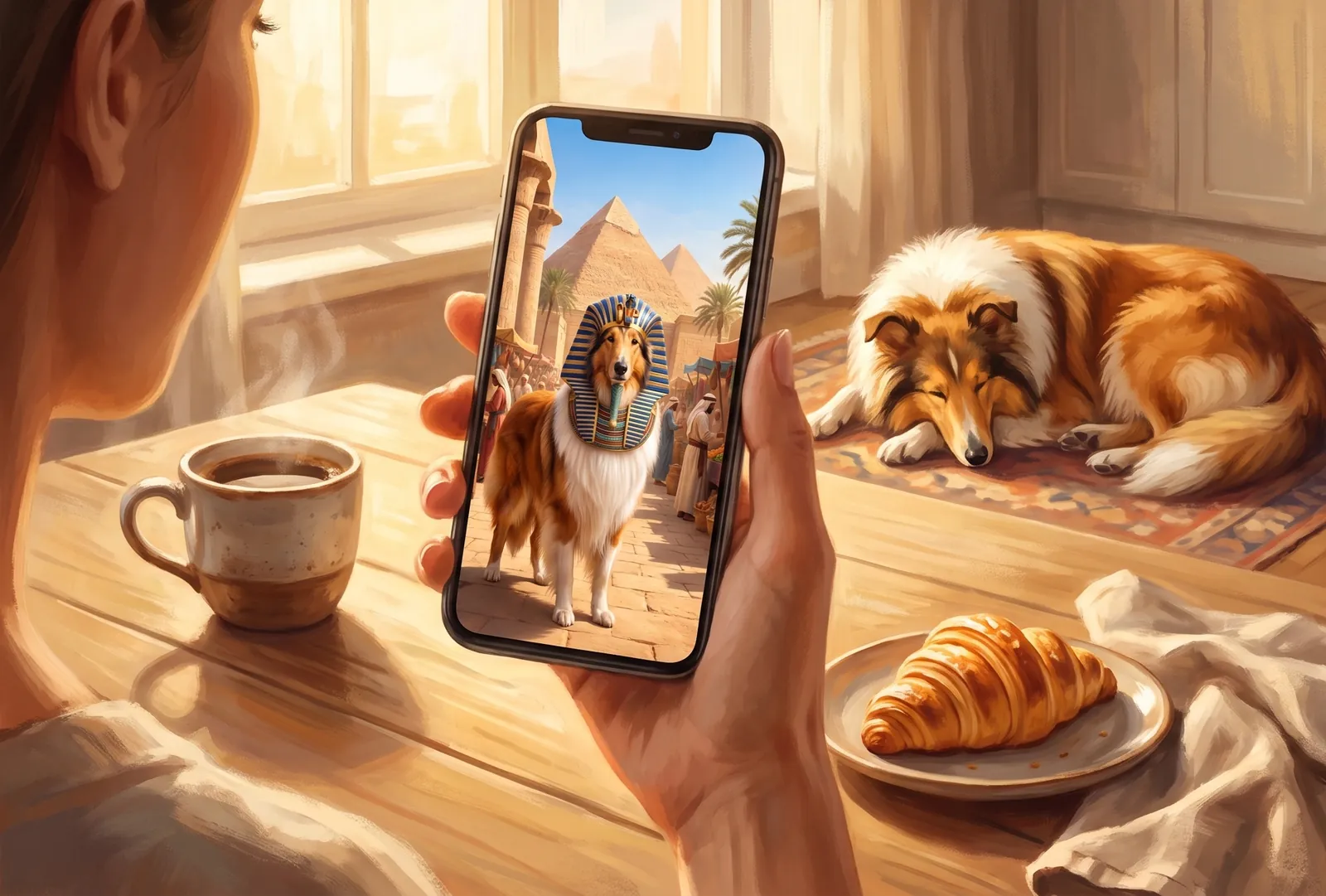
TimeWalkies paints your dog into a famous moment from history and sends it as a postcard. A new place and time every morning.
How TimeWalkies works
 Choose a photo of your dog.
 You get your first TimeWalkies postcard immediately!
 Then you get another one for free.
 If you like them, keep them coming every day for $99 for a whole year (about 27¢ per day, one‑off payment, no auto‑renewal).
2 free postcards. No credit card.
The story in 4 parts
A short version first. The full story, with every detail, is further down.
Part 1
What daily life looked like for a medieval dog
They herded sheep and cattle, guided the blind, and defended properties, much as working dogs do today.
Part 2
Dogs in medieval law and property records
As far back as the reign of King Cnut, in the early eleventh century, commoners were banned from owning greyhounds.
Part 3
Dogs in medieval hunting manuscripts
Medieval hunting manuals sometimes included detailed illustrations of dogs.
Part 4
From medieval types to modern breeds
Strict social rules kept different working dogs from breeding with each other, which encouraged distinct regional types long before formal breed standards existed.
Read the full story
Part 1
What daily life looked like for a medieval dog
They herded sheep and cattle, guided the blind, and defended properties, much as working dogs do today. Some dogs had less expected jobs too, turning a spit to rotate meat over a fire or baiting bulls before slaughter, since many people believed that meat from an unbaited bull was unfit to eat. The mastiffs who guarded London Bridge reportedly earned up to ten pence a week for their work. Hunting dogs such as greyhounds stood well above lap dogs and curs in the medieval mind, reflecting how closely a dog's status tracked its owner's.
Lymers and other hunting hounds lived in purpose-built kennels, and poor servants sometimes slept alongside them there to stay warm and to fetch help if a dog fell ill. Greyhounds often had the run of the castle itself.
Part 2
Dogs in medieval law and property records
As far back as the reign of King Cnut, in the early eleventh century, commoners were banned from owning greyhounds. By 1390, under King Richard II, parliament barred anyone with land worth less than forty shillings a year, or clergy with a benefice worth less than ten pounds, from keeping one. The rule was framed as keeping people at church on Sundays instead of hunting, but it also drew a firm line between the landed nobility and a rising middle class.
Forest law required large dogs to be lawed, or expeditated, a procedure that cut three claws from a front paw so the dog could no longer chase deer. A stirrup-shaped gauge was sometimes used to measure a dog: one that could pass through was spared, and one that could not was mutilated. Owners could pay a fine instead, sometimes called houndsilver, and at the Cheshire forest eyre of 1357 thirty people living within Macclesfield Forest chose to pay rather than have their dogs maimed. In 1209, Roger Wandard of Northamptonshire was fined simply for owning a greyhound against the assize. Between 1207 and 1212 alone, forest law generated total revenue of eleven thousand five hundred pounds, though only a small part came from fines on unlawed dogs.
Court records also show that some owners could win exemptions from the rule. In 1279, Isabel de Fortibus, Countess of Albemarle, won an exemption covering up to thirty-two of her dogs. Towns regulated dogs as well: Norwich ordered in 1354 that dogs be tied up or kept in an enclosure, and London's 1386 proclamation fined an owner forty pence for letting a dog wander loose unless it belonged to the gentry. Foresters who managed these rules stood to profit from them, and profit seems to have been part of the point. In 1305, residents of the Chase of Knaresborough complained that foresters tried to collect fines despite an exemption they held.
Part 3
Dogs in medieval hunting manuscripts
Medieval hunting manuals sometimes included detailed illustrations of dogs. One of the best-known examples is the Livre de chasse, a hunting manual completed in 1387 by Gaston III, Count of Foix, which included detailed illustrations of dogs, huntsmen, and quarry. The manuscript covered the training of each type of hunting dog and was later translated into English as The Master of Game. Copies of the book circulated widely across Europe in manuscript form. These images, along with the five types of hunting dog the book described, show how medieval hunters organized their dogs by role.
- Greyhounds hunted by sight and were the most prized dogs among medieval hunters.
- Mastiffs were used to hunt boar.
- Alaunts were used for hunting deer.
- Running hounds tracked fox.
- Terriers hunted rats, squirrels, foxes, and badgers.
- Spaniels were used for hawking.
Part 4
From medieval types to modern breeds
Strict social rules kept different working dogs from breeding with each other, which encouraged distinct regional types long before formal breed standards existed. Formal breed designations were not established until the nineteenth century. Greyhounds, salukis, and Afghan hounds are said to carry that sighthound tradition forward, while beagles, dachshunds, and other scenthounds trace back to the running hound packs of the period.
Questions people ask
What breeds of dogs existed in medieval times?
Medieval sources describe types rather than modern breeds, including greyhounds, mastiffs, alaunts, running hounds, terriers, and spaniels, each suited to a different hunting task. These functional groupings, not formal breed standards, shaped the ancestors of dogs such as the greyhound, saluki, and beagle.
Did medieval peasants own dogs?
Yes, commoners could own small dogs, though English law barred them from keeping greyhounds and restricted large hunting dogs living near royal forests.
Why were dogs important in medieval households?
Dogs herded livestock, guarded property, guided the blind, and even turned spits to cook meat, making them part of daily working life. Kings also had officials responsible for training and caring for their hunting dogs.
How were dogs treated in medieval Europe?
Treatment varied by rank and setting: valuable working and hunting dogs were carefully kept, sometimes housed alongside kennel staff, while dogs living near royal forests could be legally mutilated to stop them chasing deer. Owners could sometimes pay a fine instead of having their dog maimed.
Did medieval churches allow dogs inside?
If you're wondering about your own dog, it may be worth simply asking a local place of worship about its own custom.
Your first 2 postcards are free, with no credit card. After that, it is $14.99 a month, or a one-time $99 Year Pass for 365 days. Give TimeWalkies as a gift.
Sources
- Regulating the Working Dog in Medieval England. Legal History Miscellany, May 9, 2023.
- Royal forest - Wikipedia. en.wikipedia.org.
- The Forest Charter, 1217. The History of England.
- New Forest: medieval dog maiming | New Forest Commoner. New Forest Commoner | Practising an ancient way of life, Jun 11, 2017.
- Hunting Dogs of the Middle Ages. Mr Pet Lover, May 11, 2026.
- Forest Laws: Medieval England, History, Crime | Vaia. Vaia.
- Forepaw Mutilation in Medieval England: Did Robin Hood Help the Dogs?. doglawreporter-bay-net.blogspot.com.
- Hierarchy and Insurrection in the Medieval Forest. doglawreporter-bay-net.blogspot.com.
Written by TimeWalkies EditorialLast updated How we research