
Greyhound in ancient Egypt: myth, art, and what's true
See the real story – guest starring your dog.
If you've seen photos of slender dogs carved into Egyptian tomb walls, you may have wondered whether your own dog's history reaches that far back. Egyptian art does show a lean hunting dog with a curly tail and erect ears, much like a greyhound. Egyptologists say identifying exact breeds from this art is difficult, since ancient Egyptian names for dogs differed from modern breed names. Here's what the record actually shows, and where the popular story gets ahead of it.
What is TimeWalkies?
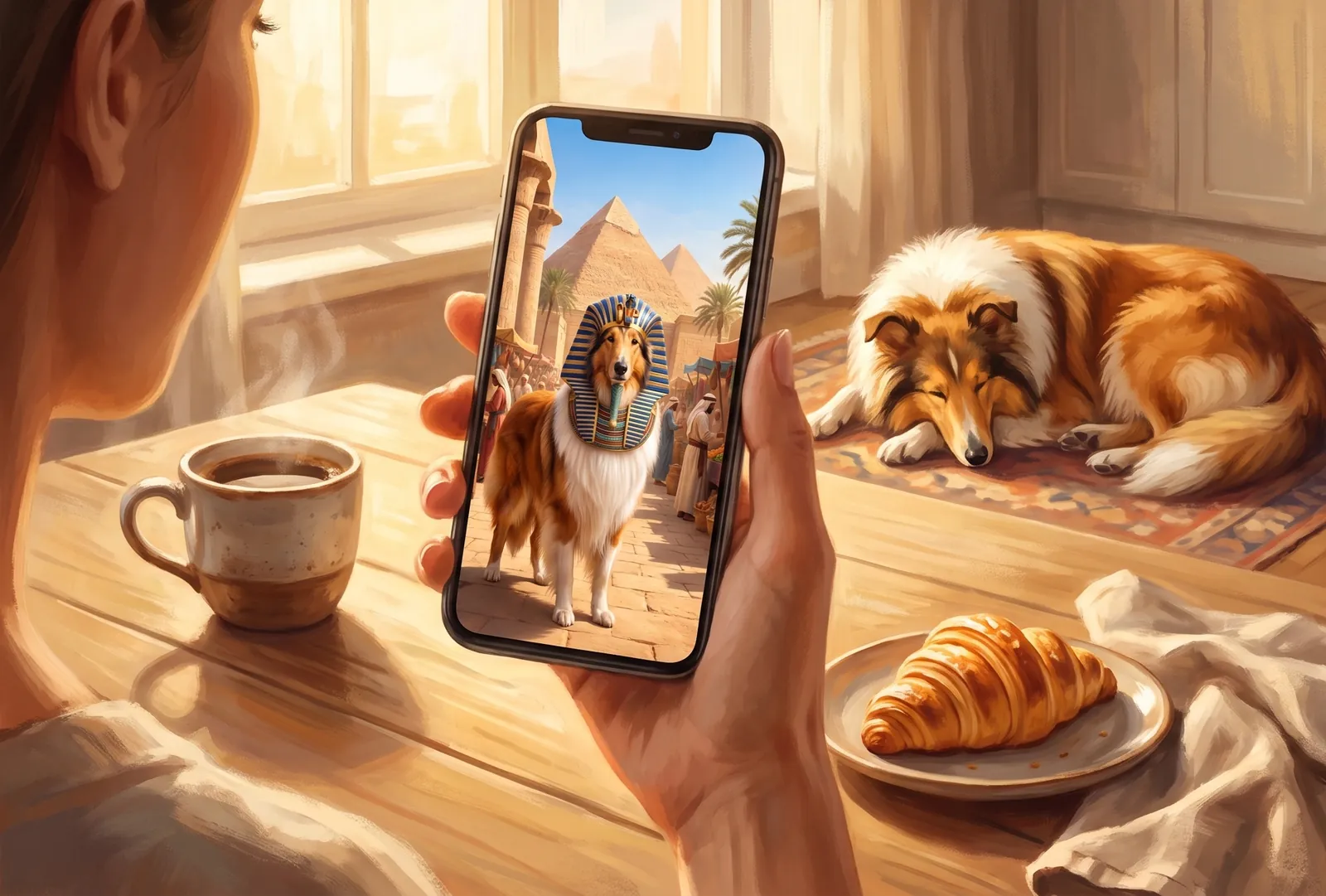
TimeWalkies paints your dog into a famous moment from history and sends it as a postcard. A new place and time every morning.
How TimeWalkies works
 Choose a photo of your dog.
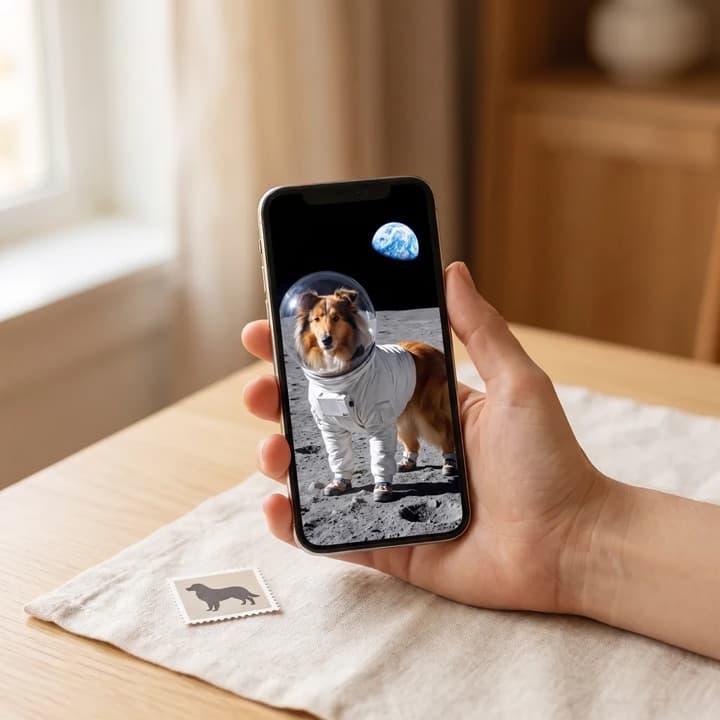 You get your first TimeWalkies postcard immediately!
 Then you get another one for free.
 If you like them, keep them coming every day for $99 for a whole year (about 27¢ per day, one‑off payment, no auto‑renewal).
2 free postcards. No credit card.
The story in 5 parts
A short version first. The full story, with every detail, is further down.
Part 1
What the evidence actually shows
One of the earliest known Egyptian tomb paintings, dated to around 3500 BCE, shows a man walking his dog on a leash.
Part 2
Dogs in Egyptian religion and daily life
Your dog's ancient counterparts earned their keep as hunting partners.
Part 3
Named dogs from the archaeological record
One dog, named on a stela or collar, was called Brave One.
Part 4
From the Nile to modern sighthounds
Sighthound-type dogs are said to have traveled beyond Egypt with traders.
Part 5
Separating popular myth from the record
It helps to be clear about what's confirmed and what's guesswork when you read about your dog's distant history.
Read the full story
Part 1
What the evidence actually shows
One of the earliest known Egyptian tomb paintings, dated to around 3500 BCE, shows a man walking his dog on a leash. Later tomb reliefs from the Old Kingdom show hunting dogs chasing gazelle and ibex across the desert alongside their owners. Egyptologists describe this dog as a sighthound, built with erect ears and a curling tail, and note that it looked much like a greyhound.
Even so, historians are careful about calling every one of these dogs a greyhound. Ancient Egyptian sources didn't use breed names the way you would today; instead they used general words, iwiw for a barking dog and tesem for a hunting hound. Because modern breed definitions aren't flexible enough to map neatly onto ancient art, identifying a specific breed from a single painting or relief is genuinely difficult.
The Greyhound's own origins are contested among historians, too. Graves containing sighthound-type dogs appear in Mesopotamia from around 5000 BCE, and similar dogs show up in Egyptian imagery from around 4250 BCE. Graves with sighthound-type dogs in Mesopotamia date to around 5000 BCE, while similar dogs appear in Egyptian imagery from around 4250 BCE. The Tesem, an Egyptian term for a hunting dog, appears in Predynastic depictions, making it one of the oldest documented dog types.
Part 2
Dogs in Egyptian religion and daily life
Your dog's ancient counterparts earned their keep as hunting partners. The Greyhound-type dog was used in open-area hunts for large game, and was also kept as a pet and guard dog. Other tomb paintings, from the Old Kingdom through the New Kingdom, show hunting dogs chasing gazelle and ibex in the desert beside their owners.
Historians think this link grew out of real desert dogs and jackals that scavenged around shallow early graves, which may be why Egyptians placed a canine god in charge of protecting the dead. Some accounts say Anubis's image drew on more than one kind of dog, including sighthounds such as the Greyhound and the Basenji, alongside the jackal. Dog mummies have also been found at several Egyptian sites, including Rhoda in Upper Egypt and near Thebes.
A stela of the ruler Intef Wahankh the Second shows him with three of his dogs standing before him. Other sources describe the dog of King Khufu, builder of the Great Pyramid, as buried within it.
Part 3
Named dogs from the archaeological record
- One dog, named on a stela or collar, was called Brave One.
- Another was called Reliable.
- A third dog bore the name North-Wind.
- Another dog was named Good Herdsman.
- And one dog was simply called Useless.
One example of this care is Abutiu, a royal guard dog who died before 2280 BCE, during Egypt's Sixth Dynasty. When Abutiu died, a pharaoh whose name has not survived ordered an elaborate ceremonial burial for him, including a coffin from the royal treasury, fine linen, and incense. The inscription describes Abutiu as a sighthound with erect ears and a curling tail, much like a greyhound.
Part 4
From the Nile to modern sighthounds
Sighthound-type dogs are said to have traveled beyond Egypt with traders. Phoenician traders are said to have carried Egyptian hounds to the island of Ibiza around 3,000 years ago. Phoenician traders are also said to have brought Egyptian hounds to Malta about 2,500 years ago. The Greyhound may also be the breed shown in Egyptian battle scenes, including the Victory Stele of Ramesses the Second celebrating his triumph over the Hittites at Kadesh.
The Saluki is described as dating back to around 7000 BCE, while the Greyhound is called possibly the oldest type of hunting dog, with ancestors shown in Egyptian tomb paintings around 5,000 years old. Those are two different claims about two different dogs, which is a sign that oldest-breed titles depend on which source, and which dog, you happen to be reading about.
Part 5
Separating popular myth from the record
It helps to be clear about what's confirmed and what's guesswork when you read about your dog's distant history. What's confirmed is that Egyptian art shows slender, sighthound-type dogs from the Pre-Dynastic period onward, and some of these dogs had individual names and elaborate burials.
So treat bold claims about a direct ancestry between Anubis and your dog's breed with some caution. What you can say with confidence is that dogs much like sighthounds walked beside Egyptians for thousands of years, were named, sometimes mourned, and sometimes buried with royal honours.
Questions people ask
Did ancient Egyptians really own greyhounds?
Egyptian art shows lean, long-legged hunting dogs with erect ears and curling tails that look much like a greyhound. Ancient Egyptians did not use the name Greyhound; instead they used words like tesem for hunting dogs.
What was the oldest named dog in ancient Egypt?
Abutiu, a royal guard dog who died before 2280 BCE, is one of the earliest named dogs documented in the archaeological record. A pharaoh whose name is unknown ordered an elaborate ceremonial burial for him.
Why is Anubis shown as a dog or jackal?
Historians think the link grew from real desert dogs and jackals that scavenged around shallow early graves. Placing a canine god in charge of the dead may have been a way to protect graves from the same animals that disturbed them.
Were Egyptian dogs given names?
Yes, Egyptian dogs were regularly named, and their names were sometimes written on collars. Recorded names include Brave One, Reliable, North-Wind, Good Herdsman, and Useless.
Is the modern Greyhound descended directly from ancient Egyptian dogs?
Sighthound-type dogs appear in both Egyptian and Mesopotamian art from thousands of years ago. Some modern breeds, such as the Ibizan Hound and Pharaoh Hound, are said to descend from Egyptian hounds brought abroad by Phoenician traders.
What other sighthound breeds trace back to Egyptian hounds?
The Ibizan Hound is said to descend from Egyptian hounds brought to Ibiza by Phoenician traders around 3,000 years ago. The Pharaoh Hound's ancestors are thought to have been brought to Malta by Phoenician traders around 2,500 years ago.
Your first 2 postcards are free, with no credit card. After that, it is $14.99 a month, or a one-time $99 Year Pass for 365 days. Give TimeWalkies as a gift.
Sources
- Dogs in Ancient Egypt. World History Encyclopedia, Mar 13, 2017.
- Abutiu - Wikipedia. en.wikipedia.org.
- Get to Know the Sighthound Breeds. American Kennel Club.
- Dogs in Ancient Egypt: The Early Origins of Man’s Best Friend | TheCollector. TheCollector, Jan 1, 2023.
- Companions and Guardians: Dogs and Jackals in Ancient Egypt — Glencairn Museum. Glencairn Museum.
- Anubis Was Real: Egypt’s Dogs and the Afterlife | Dogs in History. Dogs in History.
- Dogs in Ancient Egypt. The Curious Egyptologist, Aug 29, 2021.
- Mechanical Dog: A. Live Science, Mar 17, 2025.
Written by TimeWalkies EditorialLast updated How we research