
Famous greyhounds in history: notable dogs across the centuries
Settle in with your dog and look back at greyhounds through history. See the real story – guest starring your dog.
Ancient Egypt had a dog named Abutiu, a sighthound similar to a greyhound, who received a royal burial before 2280 BC. Centuries later, organised greyhound track racing began in Britain at Belle Vue Stadium in Manchester in 1926. Along the way, they picked up a reputation for speed and grace that still shapes how you see the breed today.
What is TimeWalkies?
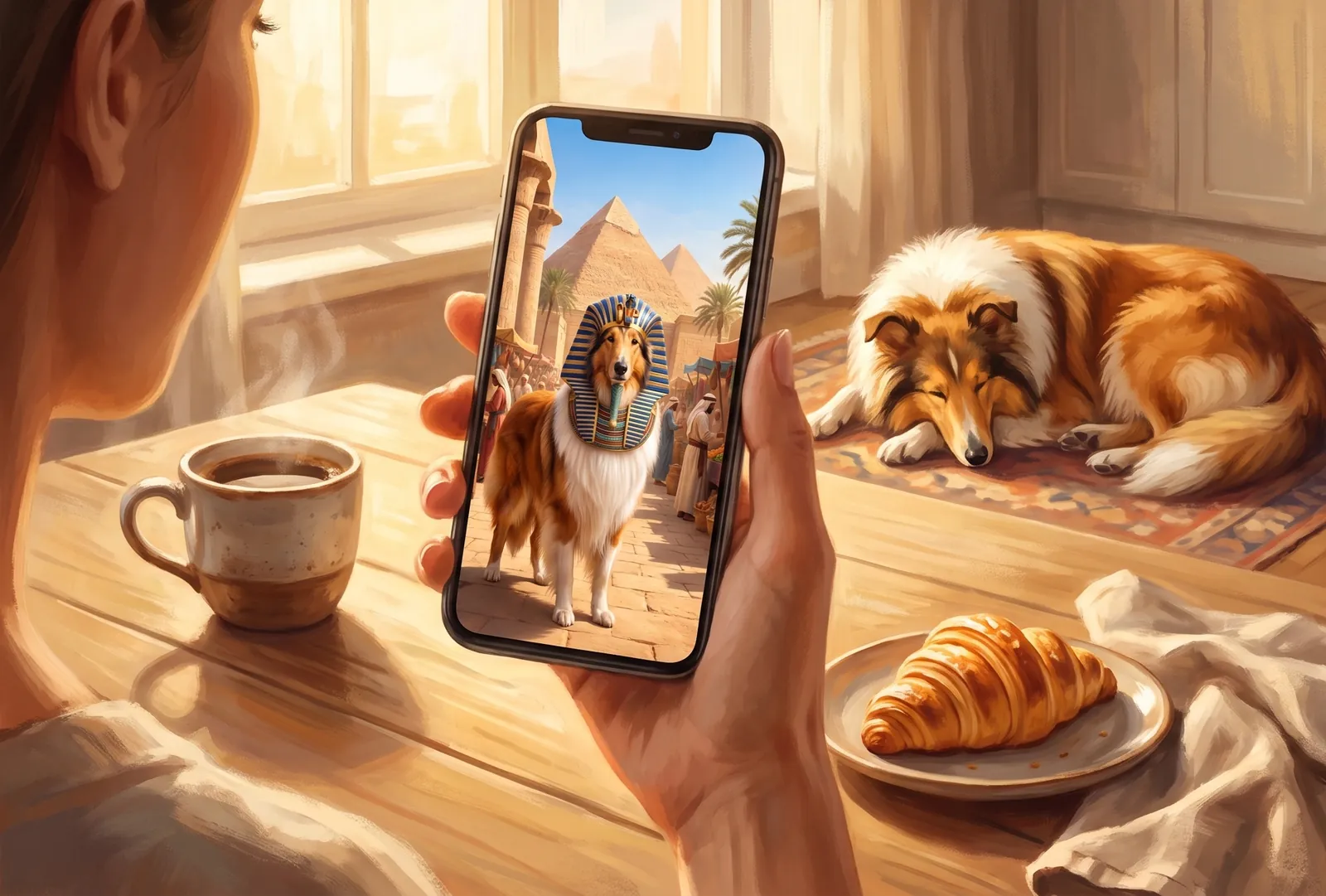
TimeWalkies paints your dog into a famous moment from history and sends it as a postcard. A new place and time every morning.
How TimeWalkies works
 Choose a photo of your dog.
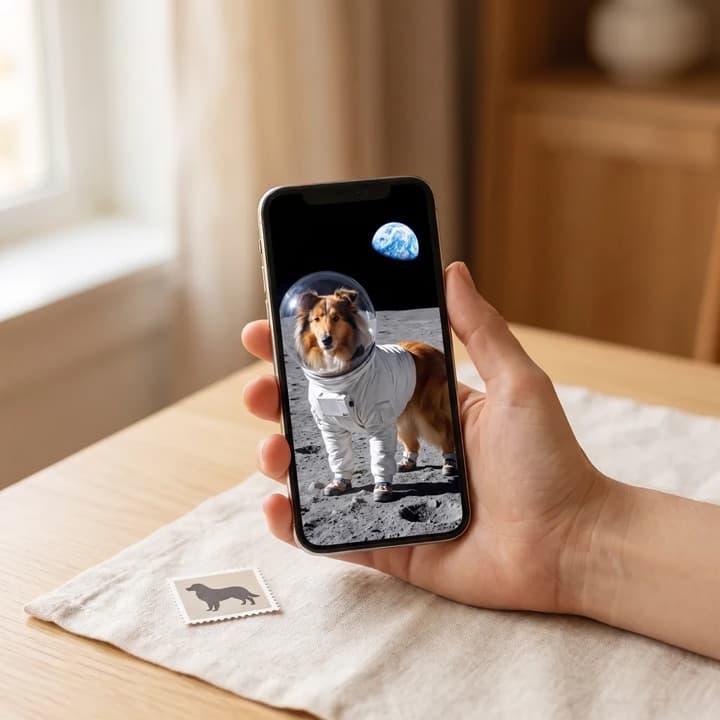 You get your first TimeWalkies postcard immediately!
 Then you get another one for free.
 If you like them, keep them coming every day for $99 for a whole year (about 27¢ per day, one‑off payment, no auto‑renewal).
2 free postcards. No credit card.
The story in 2 parts
A short version first. The full story, with every detail, is further down.
Part 1
Ancient roots: greyhounds in Egypt
If you have ever wondered how far back a dog's story can be traced, greyhounds take you further than most breeds.
Part 2
Greyhounds in racing history
Modern greyhound racing grew out of coursing, an older sport where dogs chased live hares.
Read the full story
Part 1
Ancient roots: greyhounds in Egypt
If you have ever wondered how far back a dog's story can be traced, greyhounds take you further than most breeds. The inscription for Abutiu described him as a Tesem hound, lightly built with erect ears and a curly tail, much like a greyhound. These dogs appear hunting gazelle and other prey alongside their owners in Old Kingdom tomb paintings. The Tesem type also appears in predynastic depictions, making it one of the oldest dog types with a continuous image record in Egypt. You can still see that same basic shape, a light frame built for the chase, when you look at greyhounds today.
Abutiu, an ancient sighthound, died before 2280 BC during Egypt's Sixth Dynasty. An inscription discovered by archaeologist George Reisner in October 1935 records that a pharaoh ordered an elaborate ceremonial burial for Abutiu, complete with a coffin from the royal treasury, fine linen, and incense. The text names Abutiu as a Tesem, described the same way as other greyhound-like sighthounds of the period: lightly built, with erect ears and a curly tail. Neither Abutiu's tomb nor his mummy has ever been found, and only the inscribed stone survives, now held in the Egyptian Museum in Cairo.
Egyptian dogs were often given individual names, and more than seventy have been translated from collars, stelae, and tomb reliefs, including names like Brave One and North-Wind. Dogs in ancient Egypt were also linked to Anubis, the jackal-headed god associated with mummification and the afterlife. One noble at Giza even had his own dog shown holding the leash in his tomb chapel, presented as a companion rather than a mere possession. If your own dog ever tugs you along on a walk, it is worth remembering that dogs and their leashes have been pictured together for thousands of years.
- Abutiu died before 2280 BC and is one of the earliest domestic animals whose name has survived.
- The stone recording his burial was found in Giza's Western Cemetery in October 1935.
- He is believed to have served as a royal guard dog during Egypt's Sixth Dynasty, around 2345 to 2181 BC.
Part 2
Greyhounds in racing history
Modern greyhound racing grew out of coursing, an older sport where dogs chased live hares. The first official coursing meeting on record took place in 1776 at Swaffham in Norfolk, under rules set by the Swaffham Coursing Society. Coursing by proxy with an artificial lure was introduced at Hendon in 1876, when six greyhounds raced over a straight course chasing an artificial hare, though the idea did not catch on at the time. Track racing with a mechanical hare took hold in the United States, where Owen Patrick Smith opened the first professional dog-racing track in Emeryville, California, in 1919. The sport reached Britain in 1926, when the first British meeting was held at Belle Vue Stadium in Manchester on 24 July, in front of 1,700 spectators.
Attendance rose quickly, reaching around 16 million in 1929, and racing hit its peak just after the Second World War, when 1946 totalisator turnover reached about £196 million. You may recognise some of the names that made the sport famous in that era, since greyhounds like Mick the Miller, Ballyregan Bob, and Scurlogue Champ were covered in the mainstream press. The English Greyhound Derby, first run in 1927 at White City, became the sport's most sought-after prize, and the final once drew a crowd of 92,000.
The industry declined from the early 1960s, after the 1960 Betting and Gaming Act allowed off-course cash betting away from the tracks. Iconic venues closed one by one over the following decades, including White City in 1984, Hackney Wick in 1997, and both Wimbledon and Hall Green in 2017. By January 2025, there were 18 licensed greyhound stadiums left in the United Kingdom, down from seventy-seven tracks in the late 1940s. Welfare concerns about racing greyhounds, including injuries and what happens to dogs once their racing careers end, have shaped regulation of the sport in recent years. If you share your life with a greyhound today, that long history of speed, ceremony, and changing fortunes is part of the breed's story.
Questions people ask
Who was Abutiu?
Abutiu was an Egyptian dog who died before 2280 BC and received an elaborate ceremonial burial ordered by a pharaoh. He is one of the earliest domestic animals whose name has survived, and he is believed to have been a royal guard dog.
What breed was Abutiu?
The inscription describes Abutiu as a Tesem, a lightly built hunting dog with erect ears and a curly tail, similar to a greyhound.
When did greyhound racing start in Britain?
The first British greyhound race took place at Belle Vue Stadium in Manchester on 24 July 1926, in front of 1,700 spectators.
Why did greyhound racing decline in the UK?
Attendance fell after the 1960 Betting and Gaming Act allowed off-course cash betting, and many tracks later closed as land became more valuable for other uses.
How many greyhound tracks are left in the UK?
As of January 2025 there were 18 licensed greyhound stadiums in the United Kingdom, down from seventy-seven tracks in the late 1940s.
Was Abutiu's tomb ever found?
No, neither his tomb nor his mummy has ever been recovered, and only the inscribed stone recording his burial survives.
Your first 2 postcards are free, with no credit card. After that, it is $14.99 a month, or a one-time $99 Year Pass for 365 days. Give TimeWalkies as a gift.
Sources
- Abutiu - Wikipedia. en.wikipedia.org.
- Abutiu - Wikipedia. en.wikipedia.org.
- Digital Giza | Abutiu (in G 2188). giza.fas.harvard.edu.
- Anubis Was Real: Egypt’s Dogs and the Afterlife | Dogs in History. Dogs in History.
- What Breed was Abuwtiyuw, One of the First Dogs Whose Name We Know?. National Purebred Dog Day®, Jun 28, 2017.
- Abuwtiyuw. engole.info.
- Greyhound racing in the United Kingdom - Wikipedia. en.wikipedia.org.
- Greyhound racing - Wikipedia. en.wikipedia.org.
- History of Greyhound Racing UK: Origins, Golden Age & Today. kinsleygreyhound.com.
Written by TimeWalkies EditorialLast updated How we research