
Poodles in baroque oil paintings: why they appear in portrait art
See the real story – guest starring your dog.
Settle in and take a look at why poodles sometimes turn up in baroque oil paintings. One example is Rembrandt's 1631 self-portrait, where he stands in rich dress beside a poodle. Dogs in portraits from this era often showed a sitter's loyalty or status. This guide walks you through why that tradition exists and what it can tell you about a dog like yours.
What is TimeWalkies?
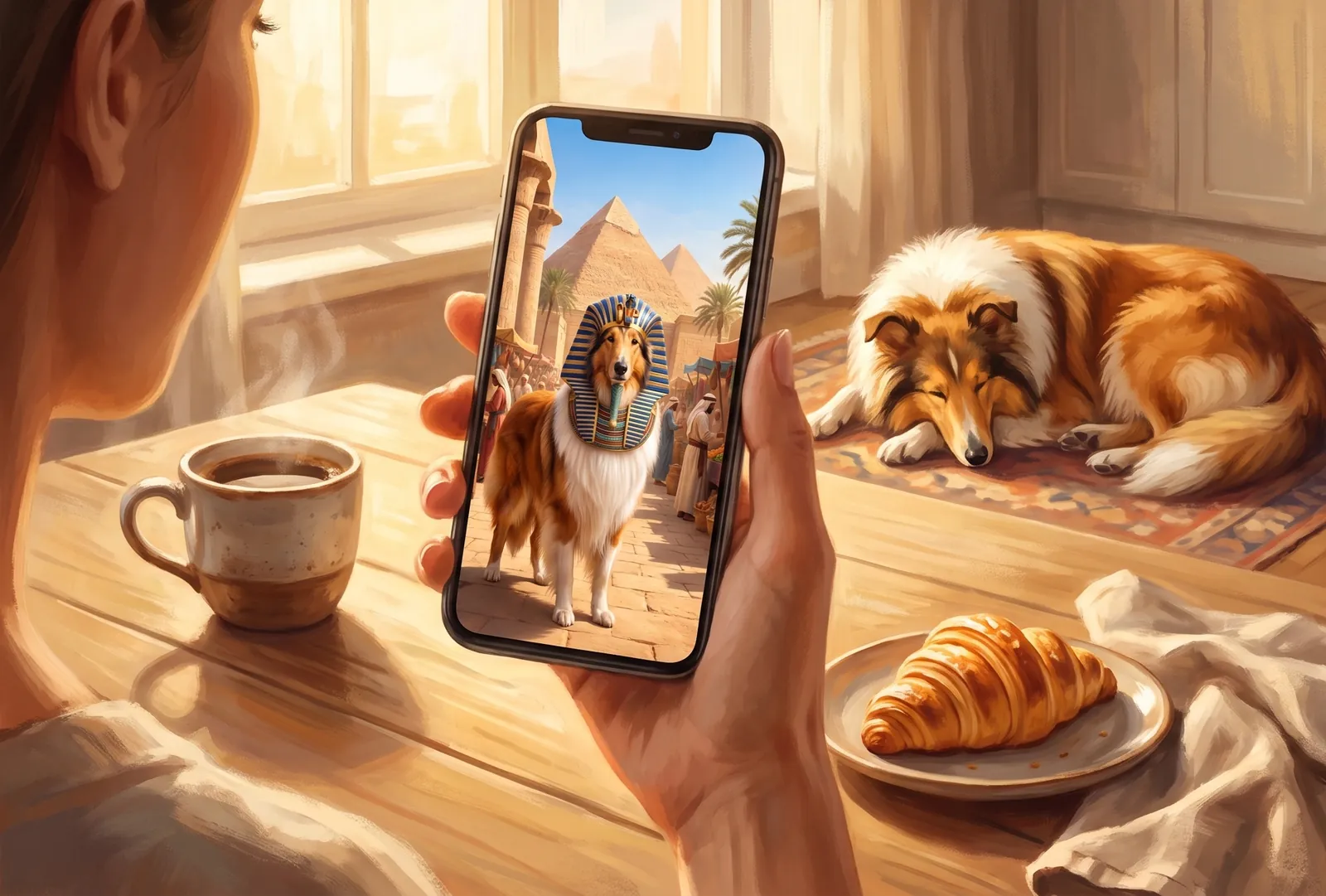
TimeWalkies paints your dog into a famous moment from history and sends it as a postcard. A new place and time every morning.
How TimeWalkies works
 Choose a photo of your dog.
 You get your first TimeWalkies postcard immediately!
 Then you get another one for free.
 If you like them, keep them coming every day for $99 for a whole year (about 27¢ per day, one‑off payment, no auto‑renewal).
2 free postcards. No credit card.
The story in 6 parts
A short version first. The full story, with every detail, is further down.
Part 1
Why poodles show up in baroque portraits
One baroque example of a poodle is Rembrandt's 1631 self-portrait, in which he appears in exotic dress with a poodle at his side.
Part 2
Notable baroque paintings featuring poodles
One documented baroque painting with a poodle is Rembrandt's Self-portrait in oriental attire with poodle, painted in 1631.
Part 3
Dogs in art across history
Dogs have appeared in art for thousands of years, long before the baroque period.
Part 4
British dog portraits after the baroque era
By the second half of the 18th century, dog portraiture was flourishing in England.
Part 5
Lapdogs and status in portraits
Lapdogs became especially fashionable with wealthy women in 18th-century France, including Madame de Pompadour and Queen Marie Antoinette.
Part 6
What this means if you want a portrait of your own dog
You do not need a poodle for a portrait of your dog to carry meaning.
Read the full story
Part 1
Why poodles show up in baroque portraits
One baroque example of a poodle is Rembrandt's 1631 self-portrait, in which he appears in exotic dress with a poodle at his side. The painting is done in oil on panel and measures about 66.5 by 52 centimetres. Art historians describe the dog as adding a personal touch, suggesting companionship, loyalty, and the upper-class status that came with keeping a pet dog. Rembrandt lived from 1606 to 1669 and worked in the Dutch Baroque style.
By the 17th century, dog portraiture had grown so established that simply showing a family's dog could signal that family's nobility. Dog breeding itself had become an obsession among established, landowning families of the period.
What small dogs symbolized in 17th-century portraits
Across the Renaissance, dogs in portraits rarely appeared by accident. Painters and patrons used them to suggest loyalty, fidelity, and the wealth it took to keep a dog. A dog beside a sitter could also stand for simple affection between the owner and the animal. Dogs in art could also represent guidance, protection, and alertness, depending on how they were posed in the scene. Even small lapdogs, not just poodles, carried this symbolic weight across European portrait painting.
Part 2
Notable baroque paintings featuring poodles
One documented baroque painting with a poodle is Rembrandt's Self-portrait in oriental attire with poodle, painted in 1631. In it, Rembrandt stands in rich, exotic dress with the dog beside him, rendered with the dramatic lighting and rich texture typical of baroque painting. Titian is particularly linked to a small dog known as the papillon, sometimes called a Titian spaniel, while Velázquez favored large mastiffs in hunting portraits of Spanish royalty.
Part 3
Dogs in art across history
Dogs have appeared in art for thousands of years, long before the baroque period. In ancient Egypt, dogs assisted their owners with guarding, watching, and hunting, and were linked to the god Anubis. In ancient Greece and Rome, people valued dogs for their faithfulness and bravery, and used them for hunting, herding, and as gifts. Roman and Greek ceramics often showed dogs to signify loyalty and dedication.
In medieval art, hunting scenes with dogs were common, since hunting with hounds was considered a noble and courtly activity. Only the wealthy could afford breeds such as spaniels, greyhounds, and mastiffs, and some laws stopped commoners from owning costly dogs or entering hunting grounds. Illuminated manuscripts sometimes showed a greyhound lying before a banquet table to reflect the high status of its owner.
Part 4
British dog portraits after the baroque era
By the second half of the 18th century, dog portraiture was flourishing in England. By the second half of the 18th century, dog portraiture was flourishing in England, and landowners commissioned stand-alone portraits of their favourite dogs. The painter George Stubbs studied animal anatomy through dissection and used that knowledge to paint working dogs and lapdogs with new sophistication from the mid-1760s onwards. Later, the Victorian painter Edwin Landseer became known for dog portraits that gave dogs feelings and intelligence, echoing the novels of his time.
Part 5
Lapdogs and status in portraits
Lapdogs became especially fashionable with wealthy women in 18th-century France, including Madame de Pompadour and Queen Marie Antoinette. Pugs were introduced to Europe from China in the late 16th century and were valued for their even temperament and willingness to sleep on their owners' feet. Owning one of these small dogs signaled wealth, since only the rich could afford them. The French Revolution later turned against these fashionable lapdogs, and many were released onto the streets of Paris.
The history of dogs appearing in art is very old; some depictions of dogs are thought to be eight to nine thousand years old. Across eras, dogs in art have been used to suggest guidance, protection, loyalty, faithfulness, alertness, and love.
Part 6
What this means if you want a portrait of your own dog
You do not need a poodle for a portrait of your dog to carry meaning. A dog beside its owner has often been read as a sign of loyalty, depending on the context and the dog's breed. If you look closely at a portrait of your dog, you might notice how its pose or placement echoes these old habits of baroque and renaissance painters.
Things you might not know
- Dogs in portraits from this era often showed a sitter's loyalty or status.
- By the 17th century, dog portraiture had grown so established that simply showing a family's dog could signal that family's nobility.
- Painters and patrons used them to suggest loyalty, fidelity, and the wealth it took to keep a dog.
- Dogs have appeared in art for thousands of years, long before the baroque period.
Year by year
- 1606Rembrandt lived from 1606 to 1669 and worked in the Dutch Baroque style.
- 1631One example is Rembrandt's 1631 self-portrait, where he stands in rich dress beside a poodle.
- 1631One documented baroque painting with a poodle is Rembrandt's Self-portrait in oriental attire with poodle, painted in 1631.
Questions people ask
Why did Rembrandt paint a poodle in his 1631 self-portrait?
Rembrandt painted himself in exotic dress with a poodle at his side, and art historians read the dog as a sign of companionship, loyalty, and the status that came with keeping a pet dog.
What do dogs usually symbolize in baroque and renaissance portraits?
Dogs in these portraits often stood for loyalty, fidelity, and companionship, and could also suggest guidance, protection, and alertness depending on how they were shown.
Were poodles common in baroque portrait paintings?
In 1631 Rembrandt painted a self-portrait in oriental attire with a poodle at his side.
What other dogs appear in baroque-era portraits?
Painters such as Van Dyck, Titian, Velázquez, and Rubens included dogs in their work, with Titian linked to a small dog called the papillon and Velázquez favoring large mastiffs.
Did owning a dog show wealth in this period?
Dog breeding was an obsession among landowning families, and keeping a dog purely as a companion signaled wealth and status.
Your first 2 postcards are free, with no credit card. After that, it is $14.99 a month, or a one-time $99 Year Pass for 365 days. Give TimeWalkies as a gift.
Sources
- Self-Portrait with Poodle by Rembrandt (c. 1631). Rembrandt Harmenszoon van Rijn.
- A quick guide to Dogs in Art - Antique Collecting. Antique Collecting, May 4, 2023.
- Animal Symbolism in Fine Art and Antiques. M.S. Rau.
- The Role of Dogs in Renaissance Art: 5 Fascinating Insights. Prints4Sure.
- Dogs in Renaissance Paintings: What They Really Symbolized. www.whataportrait.com.
- Dogs in Renaissance Paintings: Past & Present. Pixels Photo Art.
- Secrets of Pets in Art. DailyArt Magazine, Jan 19, 2026.
- Renaissance Painting at the Louvre with Dogs: Unearthing Canine Companions in Masterpieces - Wonderful Museums. Wonderful Museums, Sep 18, 2026.
- Self-portrait in oriental attire with poodle (1631) by Rembrandt – Artchive. www.artchive.com.
Written by TimeWalkies EditorialLast updated How we research