
Dogs in portrait paintings: a look through art history
See the real story – guest starring your dog.
If you have ever wondered why so many old portraits show a small dog tucked under an arm or curled on a lap, you are not alone. Painters often included a dog to suggest the sitter's faithfulness. Here is a walk through some of the paintings that made dogs part of portrait art.
What is TimeWalkies?
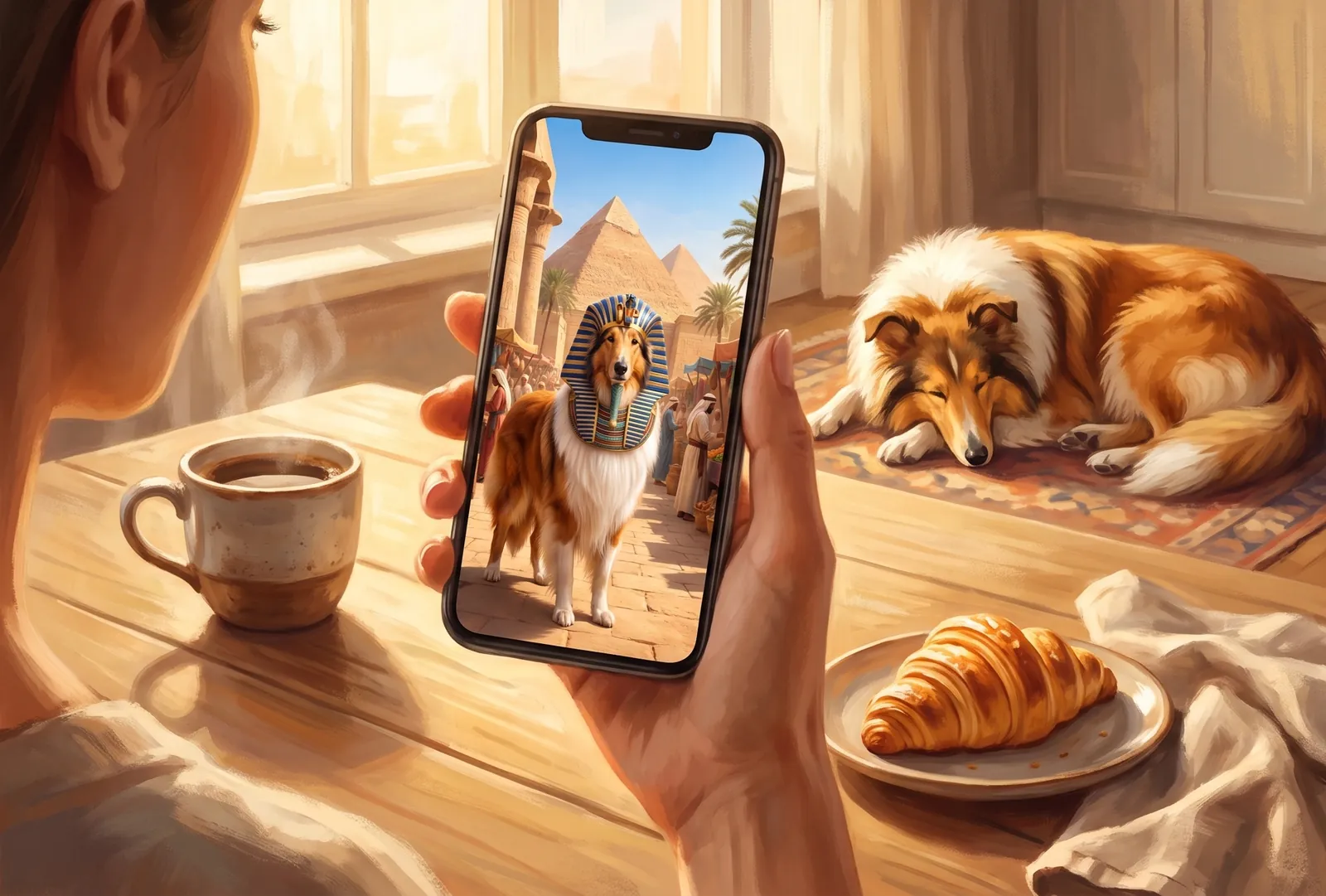
TimeWalkies paints your dog into a famous moment from history and sends it as a postcard. A new place and time every morning.
How TimeWalkies works
 Choose a photo of your dog.
 You get your first TimeWalkies postcard immediately!
 Then you get another one for free.
 If you like them, keep them coming every day for $99 for a whole year (about 27¢ per day, one‑off payment, no auto‑renewal).
2 free postcards. No credit card.
The story in 5 parts
A short version first. The full story, with every detail, is further down.
Part 1
Why painters put a dog next to the sitter
In one late sixteenth-century Italian portrait, an unknown noblewoman stands with her hand resting on a small dog lying on a carpet-covered table.
Part 2
A queen's dog becomes a trend
Not every dog in a portrait was the sitter's actual dog.
Part 3
Dogs across the centuries
Italian Renaissance painter Sofonisba Anguissola painted a work known as Lady and Her Dog, and Lavinia Fontana painted Lady with a Lapdog in 1595.
Part 4
The Victorian dog art boom
The Victorian era, running from 1820 to 1914, is often described as the most prolific period for dog art.
Part 5
What these paintings tell you about your own dog
None of this history changes how your own dog looks at you, but it does show how long people have wanted to keep a likeness of that bond.
Read the full story
Part 1
Why painters put a dog next to the sitter
In one late sixteenth-century Italian portrait, an unknown noblewoman stands with her hand resting on a small dog lying on a carpet-covered table. The dog may be a pointer puppy or an Italian greyhound, and its white and gold coat matches the colours of the woman's clothes. The gallery that holds this painting notes that dogs were often included in portraits to symbolise the sitter's faithfulness. A gold and ruby ring on the woman's hand may also point to her marriage. You can see a similar idea in a portrait of Queen Elizabeth I, painted between 1580 and 1585, where her small dog sits at her feet gazing up at her while she holds an olive branch.
Part 2
A queen's dog becomes a trend
Not every dog in a portrait was the sitter's actual dog. A 1735 American portrait of young Jacomina Winkler shows her holding a Cavalier King Charles Spaniel, but that breed had not yet reached America when the painting was made. The breed had been popularised in England by Charles II, and it appears in a portrait of his wife, Catherine of Braganza, painted by Sir Peter Lely in the 1680s. Colonial American painters imported engravings of English aristocratic portraits and copied their dogs along with their costumes and poses, so a New York merchant's daughter could be shown with a queen's dog. Decades later, John Singleton Copley painted Mrs Jerathmael Bowers with the same kind of invented spaniel, closely following an engraving after a portrait by Sir Joshua Reynolds.
Part 3
Dogs across the centuries
Italian Renaissance painter Sofonisba Anguissola painted a work known as Lady and Her Dog, and Lavinia Fontana painted Lady with a Lapdog in 1595. Dutch painters kept the theme going too, with Johannes Vermeer's Young Woman Teasing Her Lap Dog and Rembrandt's Portrait of a Lady with a Lap Dog. The habit did not stop with the old masters. An eighteenth-century exhibition at the Wallace Collection included Gainsborough's painting of his own dogs, Tristram and Fox, alongside dog portraits by George Stubbs. The same exhibition displayed Jean-Jacques Bachelier's Dog of the Havana Breed from 1768 and, from the twentieth century, David Hockney's portraits of his dachshunds Stanley and Boodge, painted in 1995.
Part 4
The Victorian dog art boom
The Victorian era, running from 1820 to 1914, is often described as the most prolific period for dog art. The period runs from 1820 to 1914 and is often described as the most prolific era for this kind of art. American artist Cassius Marcellus Coolidge became known for showing dogs in human activities, such as playing card games, and created a series of sixteen oil paintings on this theme for calendars. In Britain, Sir Edwin Landseer took a different, more sentimental approach, painting a Newfoundland named Bob who became known for rescuing people from the Thames in London. Landseer also painted Windsor Castle in Modern Times.
Part 5
What these paintings tell you about your own dog
None of this history changes how your own dog looks at you, but it does show how long people have wanted to keep a likeness of that bond. French painter Gustave Courbet also placed a dog in a self-portrait from the same broad tradition of pairing a person with their dog.
Questions people ask
Why did painters include dogs in old portraits?
Painters often used a dog in a portrait to suggest the sitter's faithfulness or loyalty. A dog could also point to the sitter's wealth or status, since some owners chose a breed favored by royalty to look just as noble.
Were the dogs in these portraits always the sitter's real dog?
Not always. A 1735 portrait of Jacomina Winkler shows a Cavalier King Charles Spaniel, a breed that had not yet reached America, so the dog was likely copied from a fashionable English engraving rather than being her own pet.
Which artists are known for painting dogs?
Sir Edwin Landseer is closely tied to Victorian dog painting, including his portrait of a Newfoundland named Bob. Gainsborough, Stubbs, Bachelier, and later David Hockney also painted dogs, with Hockney's dachshund portraits dating to 1995.
When was the most active period for dog art?
The Victorian era, running from 1820 to 1914, is often described as the most prolific period for dog art.
Did royalty commission dog portraits?
Yes, Queen Elizabeth I enjoyed commissioning portraits of her dogs, and a portrait from between 1580 and 1585 shows her small dog at her feet. Charles II of England also helped popularise the Cavalier King Charles Spaniel, which shows up in his wife's portrait.
Your first 2 postcards are free, with no credit card. After that, it is $14.99 a month, or a one-time $99 Year Pass for 365 days. Give TimeWalkies as a gift.
Sources
- Italian | Portrait of a Lady with a Dog | NG3817 | National Gallery, London. www.nationalgallery.org.uk.
- From the Collection—Duyckinck’s Jacomina Winkler (and her crabby dog!). Milwaukee Art Museum Blog, May 23, 2012.
- Portraits of Dogs: From Gainsborough to Hockney - BSECS. BSECS.
- Papillons in Art – Papillon Club of America. papillonclub.org.
- Victorian Dog Paintings - Portrait Art. www.juliespetportraits.com.
- Pet Portraiture. Victorian Visual Culture, Dec 13, 2014.
Written by TimeWalkies EditorialLast updated How we research