
Shih tzu in art: how imperial China painted its lap dogs
See the real story – guest starring your dog.
You might wonder whether the small dog in an old Chinese court painting is really a shih tzu. This guide walks you through what survives, why painters favored these dogs, and how experts try to tell a shih tzu from a close relative in old art.
What is TimeWalkies?
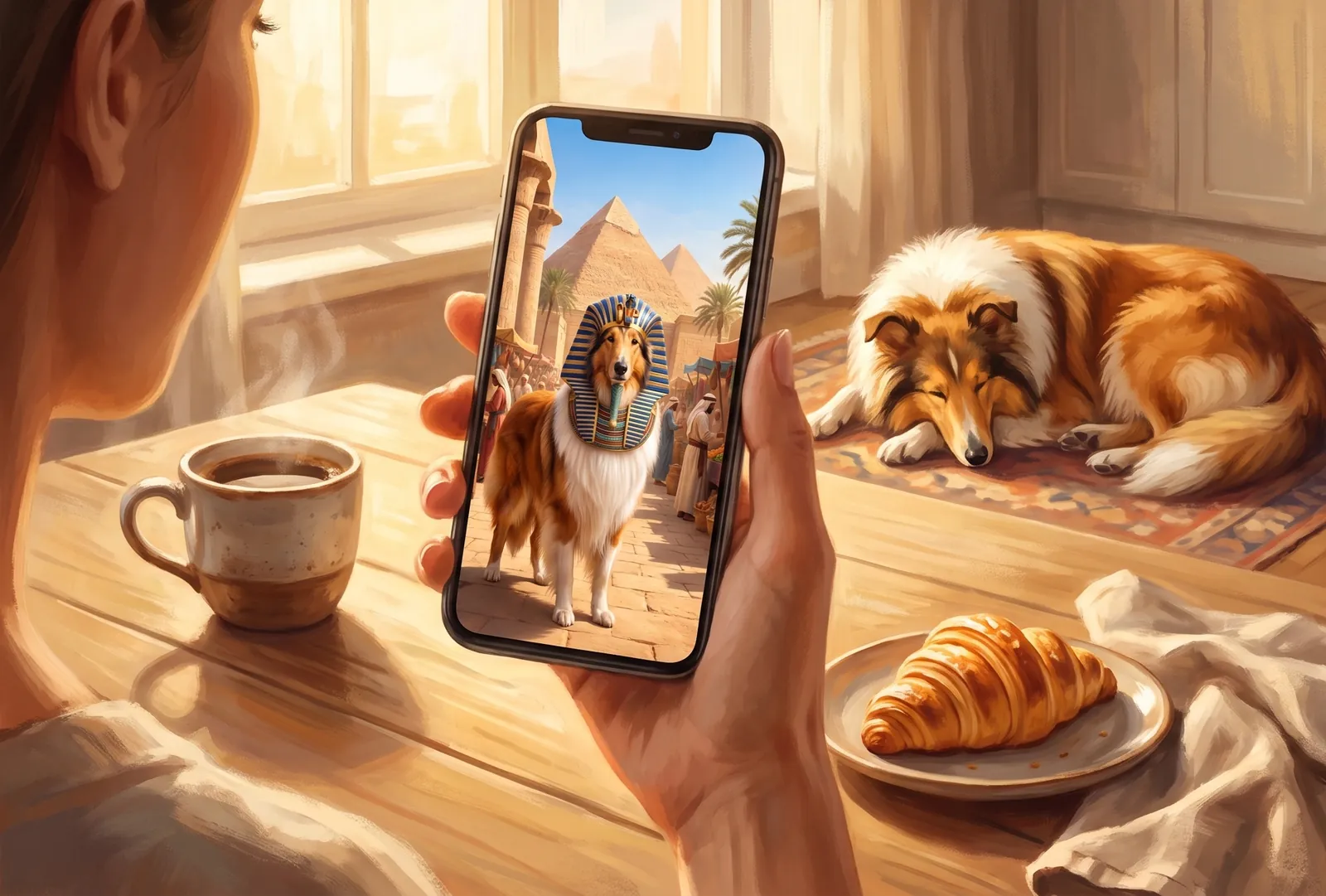
TimeWalkies paints your dog into a famous moment from history and sends it as a postcard. A new place and time every morning.
How TimeWalkies works
 Choose a photo of your dog.
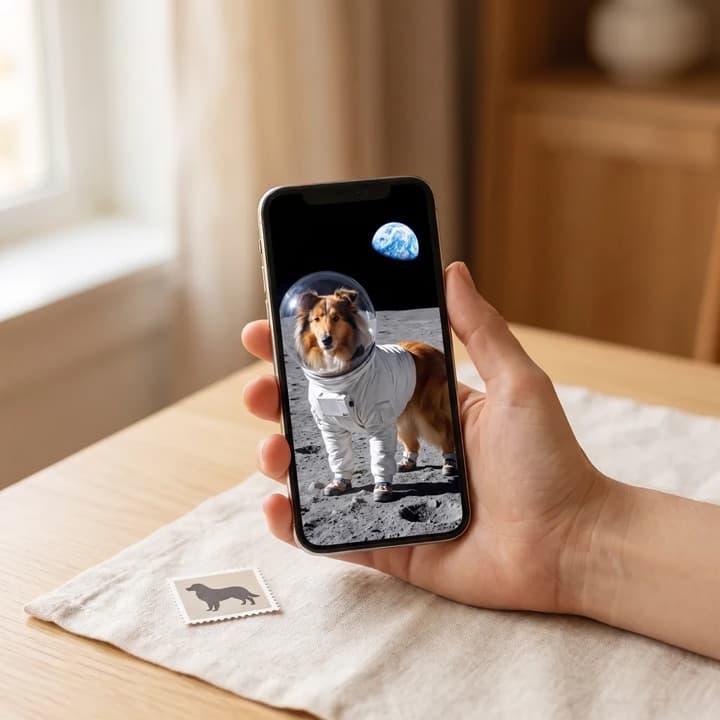 You get your first TimeWalkies postcard immediately!
 Then you get another one for free.
 If you like them, keep them coming every day for $99 for a whole year (about 27¢ per day, one‑off payment, no auto‑renewal).
2 free postcards. No credit card.
The story in 5 parts
A short version first. The full story, with every detail, is further down.
Part 1
What paintings and objects actually show a shih tzu
Breeding these dogs was delegated to court eunuchs, who competed to produce dogs that caught the emperor's eye, and the dogs they produced had their portraits painted on wall hangings and drapes in the palace.
Part 2
Why painters favored these dogs as subjects
These dogs are closely associated with Buddhist mythology.
Part 3
Spotting a shih tzu in older art versus a lookalike breed
The Lhasa Apso tends to have a longer, less square muzzle suited to a cold climate, while the shih tzu's face was shaped partly by crossing with the flatter-faced Pekingese.
Part 4
How shih tzus moved from palace art to western portraiture
No shih tzu left China until the twentieth century, unlike pugs, which reached Holland in the eighteenth century, and Pekingese, which reached Queen Victoria in the nineteenth.
Part 5
What museums and collections preserve today
Surviving Qing-era animal paintings include work by court painters such as Lang Shining, who painted a court dog for the palace in the late seventeenth century.
Read the full story
Part 1
What paintings and objects actually show a shih tzu
Breeding these dogs was delegated to court eunuchs, who competed to produce dogs that caught the emperor's eye, and the dogs they produced had their portraits painted on wall hangings and drapes in the palace. A eunuch whose dog pleased the emperor could even be rewarded with income from rice land.
One surviving example comes from the Qing court painter Lang Shining, also known as Giuseppe Castiglione, who worked for the palace in the late seventeenth century and painted a court dog. Centuries earlier, the Tang painter Zhou Fang had already painted two small lion dogs frisking around court ladies.
Not every small dog in these paintings is a shih tzu. The Dowager Empress Cixi ran a breeding program for small palace dogs, but she also kept pugs and Pekingese, and her two named favorites, Sea Dragon and Black Jade, were both Pekingese.
Part 2
Why painters favored these dogs as subjects
These dogs are closely associated with Buddhist mythology. Lions were sacred in Buddhism, and legend held that Buddha rode a lion to earth, so dogs bred to look like lions carried that same symbolism, which is part of why the shih tzu's name itself means lion. Since lions never lived in China, artists also used carved stone guardian lions, sometimes mistaken for dog breeds, to stand in for the animal.
The Dowager Empress Cixi's court gave these dogs another reason to appear in art. She developed a breeding program devoted to the shih tzu's particular traits, and court eunuchs bred the dogs hoping to win the emperor's favor.
If you keep a small dog yourself, it is worth remembering that none of this favoritism was really about the dog's comfort.
Part 3
Spotting a shih tzu in older art versus a lookalike breed
The Lhasa Apso tends to have a longer, less square muzzle suited to a cold climate, while the shih tzu's face was shaped partly by crossing with the flatter-faced Pekingese.
A dog show in Peking in the 1930s judged these long-haired dogs together, and the judge complained that the lack of uniformity among them, despite their short muzzles, long hair, and high-carried tails, made judging almost impossible. Early shih tzus brought to the United States were often registered as Lhasa Apsos instead, which kept the two breeds confused with each other for years.
Part 4
How shih tzus moved from palace art to western portraiture
No shih tzu left China until the twentieth century, unlike pugs, which reached Holland in the eighteenth century, and Pekingese, which reached Queen Victoria in the nineteenth. Lady Brownrigg, an Englishwoman living in China, brought two shih tzus to England in 1928, and the breed's modern population traces back to about thirteen dogs imported into England and Scandinavia between 1928 and 1952. After the 1949 revolution, shih tzus remaining in China were killed because the breed was linked with wealth, which makes the dogs that had already left even more important to the breed's survival.
The English nicknamed the breed the chrysanthemum dog in the 1930s, a shih tzu club formed in England in 1934, and the Kennel Club recognized the breed in 1940. The American Kennel Club entered the shih tzu into its stud book in 1969.
Part 5
What museums and collections preserve today
Surviving Qing-era animal paintings include work by court painters such as Lang Shining, who painted a court dog for the palace in the late seventeenth century. Guardian lion statues, which are not dogs but which were sometimes mistaken for Chow Chows or Pekingese, still stand outside buildings such as the Forbidden City and the Summer Palace in Beijing.
Even a Peking Kennel Club judge in the 1930s complained that the long-haired dogs lacked uniformity, making them hard to judge. That limit is worth keeping in mind the next time you read a caption that names a painted dog with total confidence.
Things you might not know
- Not every small dog in these paintings is a shih tzu.
- These dogs are closely associated with Buddhist mythology.
- The Dowager Empress Cixi's court gave these dogs another reason to appear in art.
Year by year
- 1928Lady Brownrigg, an Englishwoman living in China, brought two shih tzus to England in 1928, and the breed's modern population traces back to about thirteen dogs imported into England and Scandinavia between 1928 and 1952.
- 1934A shih tzu club formed in England in 1934,.
- 1969The American Kennel Club entered the shih tzu into its stud book in 1969.
Questions people ask
Did Chinese emperors really keep shih tzus as pets?
The Dowager Empress Cixi ran a breeding program aimed at the shih tzu's particular traits, and court eunuchs bred the dogs hoping to please the emperor. Shih tzus lived in the Chinese imperial court through the Ming dynasty and remained in the palace into the Qing dynasty under Cixi.
How can you tell a shih tzu apart from a Pekingese in old paintings?
In person, a Lhasa Apso has a longer, less square muzzle than a shih tzu, whose face was shaped partly by crossing with the Pekingese.
Why were small dogs painted so often in Chinese imperial art?
Lions were sacred in Buddhism, and small dogs bred to resemble lions carried that symbolism, which is part of why the shih tzu's name itself means lion. Breeding a dog that pleased the emperor could bring the eunuch responsible a reward of income from rice land.
When did shih tzus first appear in western art?
No shih tzu left China until the twentieth century. Lady Brownrigg brought two shih tzus to England in 1928, and the breed gained a British nickname, the chrysanthemum dog, in the 1930s.
Your first 2 postcards are free, with no credit card. After that, it is $14.99 a month, or a one-time $99 Year Pass for 365 days. Give TimeWalkies as a gift.
Sources
- Palace Museum Youth. young.dpm.org.cn.
- 'Tails' of Ancient Dogs. The World of Chinese.
- Cats in Chinese Art. DailyArt Magazine, Aug 7, 2026.
- Chinese guardian lions - Wikipedia. en.wikipedia.org.
- Dog days of summer, painting Pekingese. followmybrushmarks, Aug 16, 2017.
- Summer Palace. www.mybeijingchina.com.
- Summer Palace - Imperial Garden of the Qing Dynasty | ChinaFetching. ChinaFetching.com.
- Shih Tzu History: From Royal Dogs to Beloved Companions. American Kennel Club.
- A BRIEF HISTORY OF THE SHIH TZU | American Shih Tzu Club. shihtzu.org.
- Shih Tzu - Wikipedia. en.wikipedia.org.
- Lhasa Apso vs. Shih Tzu: Similarities and Differences. American Kennel Club.
Written by TimeWalkies EditorialLast updated How we research